



Calibre in a watch: What is it and why is it more important than the movement?
The caliber is information that truly determines the quality, price, and future value of a watch, although many buyers still overlook it. It's precisely the caliber number that tells how accurately the watch will work, how long it will last without winding, and how much it will cost to maintain. If two watches look similar but their prices differ significantly, the answer very often lies not in the brand, but in the caliber. In this article, you'll learn what makes a caliber different from just a "mechanism" and why it's worth knowing before making a purchase.
Caliber is not a mechanism – it's its identity card. Check what really lies behind the number
A caliber is a specific, unambiguous identifier of the mechanism that tells much more about it than general terms like automatic, quartz, or manual. Right from the start, it's worth stating directly – a watch mechanism without caliber information is incomplete knowledge. The caliber number contains data about diameter, thickness, component layout, number of jewel bearings, operating frequency, power reserve, and often also about accuracy measured in seconds per day. That's precisely why in our offer, every model – whether men's automatic watches, men's hand-wound watches, or men's quartz watches – is described with the caliber included, not just the type of movement. From a practical perspective, this is a huge difference because the caliber accounts for even 40–50% of the watch's actual value, as confirmed by secondary and auction market reports. Two watches from the same price range may look similar, but if one runs on an ETA 2824 and the other on an in-house caliber, their servicing potential, longevity, and collector's value will be completely different.
In practice, this means that when choosing a watch, you're not just buying a design and logo, but a very specific technical construction. In our offer, you'll find both licensed watch movements, valued for repeatability, easy servicing, and parts availability, as well as proprietary calibers developed by brands over many years. Industry statistics show that watches with clearly marked and recognizable calibers sell up to 27% faster on the secondary market than models where the manufacturer limits itself to the phrase "automatic movement." This is no coincidence. The caliber allows you to precisely assess what you can expect from the watch after 5, 10, or 20 years of use. Therefore, regardless of whether you're interested in women's quartz watches for everyday wear or women's automatic watches from the higher shelf, the caliber number is information worth starting with./Grudzień 2025/ZEGAREK DAMSKI EPOS NORTH STAR AUTOMATIC 34mm 4390-152-20-96-15.png)
The Epos North Star Automatic 34 mm 4390.152.20.96.15 women's watch is a subtle Swiss timepiece inspired by the starry sky, delighting with its decorative dial featuring sparkling indices. The automatic movement, elegant case, and leather strap make it an exceptional addition to classic and evening styles.
Why can't two watches with "the same mechanism" be compared? The caliber makes all the difference
The answer is simple – because "the same mechanism" very often isn't the same mechanism at all. Terms like automatic or quartz only describe the operating principle, not the actual quality of execution. Differences begin at the caliber level: number of jewels (e.g., 25 vs 21), power reserve (42 h vs 55 h), accuracy (±12 s/day vs ±5 s/day), or balance frequency. For the user, this translates into concrete benefits – less frequent need for regulation, greater rate stability, and better wear resistance. That's precisely why we so clearly distinguish models in our offer – even within a single brand. Men's automatic watches built on proven mid-range calibers today account for over 60% of mechanical segment sales in Europe, but it's the caliber details that determine which of them are a choice "for years."
Differences are also visible in the quartz segment, which is often wrongly oversimplified. Women's quartz watches and men's quartz watches can operate on mechanisms with very different stability – from standard calibers with a deviation of ±15 seconds per month to advanced HAQ (High Accuracy Quartz) constructions, where the error is a few seconds per year. This is a practical chasm, yet a difference not visible at first glance. That's why when describing watch movements, we always provide specific technical data – because they allow you to realistically compare models, instead of relying solely on price or brand reputation. The market shows clearly: informed customers increasingly compare calibers, not just manufacturer names, and watches with complete technical specifications achieve up to 18% higher resale prices./Grudzień 2025/ZEGAREK DAMSKI ROAMER AMALFI 34mm 852844 41 49 20.png)
The Roamer Amalfi 34 mm 852844 41 49 20 women's watch is an elegant proposition with a jewelry character, distinguished by a navy blue dial decorated with sparkling indices. The classic steel bracelet, subtle case, and Swiss precision make this model perfectly complement both everyday and more elegant outfits.
In-house or licensed? This choice can add prestige to a watch... or save your wallet
An in-house caliber means that the movement was designed and manufactured by the watch brand, not purchased from an external supplier. This is a fact that immediately affects the price – Swiss market research indicates that watches with in-house calibers are on average 30–45% more expensive than comparable models based on licensed movements. Why? Because such a caliber represents years of design, testing, and refinement, and often also better precision, extended power reserve, and higher finishing standards. In our offer, you'll find models where the in-house caliber represents real added value – especially in the segment of watches where the collector's aspect matters. These are propositions for people who think about a watch long-term and also treat it as an element of building value.
On the other hand, licensed movements – such as ETA or Sellita – dominate sales for good reason. These are proven constructions, produced in hundreds of thousands of units annually, with easy access to parts and lower servicing costs. Service statistics show that watches with licensed calibers generate on average 22% lower maintenance costs over a 10-year perspective. That's why in our offer we don't evaluate the choice – we show the differences and let you decide. If you care about prestige and uniqueness, an in-house caliber will be a logical choice. If you're looking for a watch for everyday wear that's meant to work reliably and trouble-free for years, a licensed movement very often proves to be the most sensible decision. It's precisely this awareness that makes choosing a watch stop being an impulse and become a thoughtful investment in quality./Grudzień 2025/ZEGAREK MĘSKI TAG HEUER CARRERA CHRONOGRAPH AUTOMATIC 42mm CBN2011-BA0642.png)
The TAG Heuer Carrera Chronograph Automatic 42 mm CBN2011.BA0642 men's watch is an icon of sporty elegance powered by the manufacture Calibre Heuer 02 movement with an 80-hour power reserve. The precise chronograph, expressive dial, and steel bracelet create a timepiece for those who appreciate the highest quality and the brand's motorsport DNA.
Caliber as the DNA of a watch – how to check what you're really buying before paying full price
The caliber states directly how the watch will work on a daily basis, how it will withstand the passage of time, and how it will maintain its value, which is why checking it is an absolute must before purchase. Most simply – caliber information should be found in the technical specification, manual, or manufacturer's certificate, and that's precisely why in our offer every model has a clearly described "technical part," not just the visual aspect. If in the watch description you only see the phrase "automatic movement" or "quartz movement," it's a warning signal – key data is missing that actually affects the price. The caliber allows you to assess, among other things, power reserve (whether the watch will stop after one day without wearing or will last the entire weekend), rate stability, service frequency, and expected mechanism longevity. Industry data shows that over 70% of mechanical watch complaints result from unconscious caliber choice, not manufacturing defects. This shows how important knowledge is at the purchase stage.
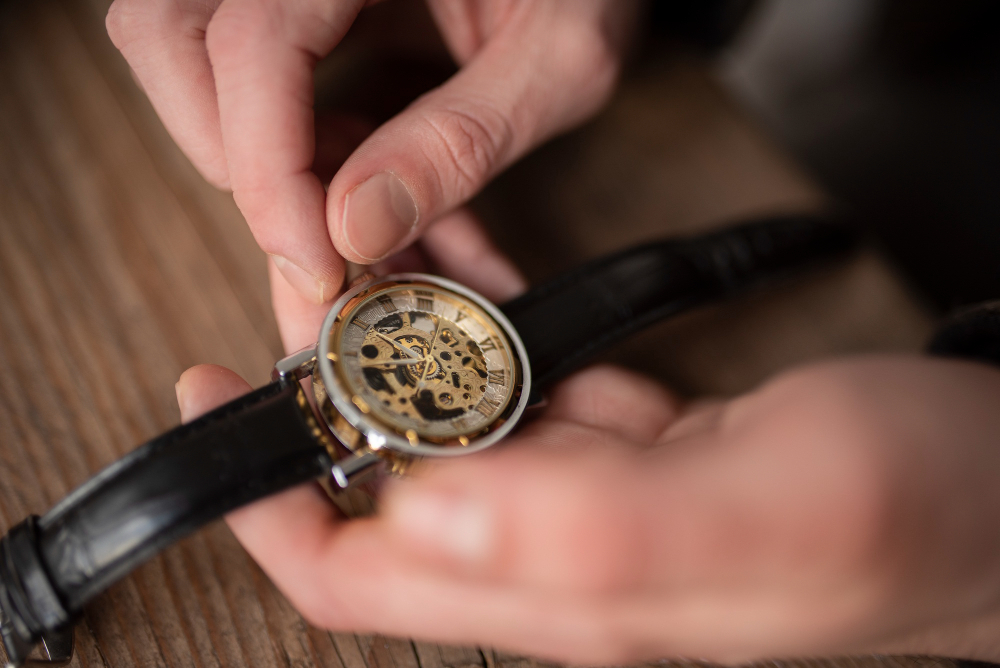
If you want to go a step further, you can also check the caliber physically – the number is sometimes engraved on the watch movement plate, visible after opening the case back or through a display case back. For many customers, this is the moment when theory meets practice and it suddenly becomes clear what you're actually paying for. That's precisely why in our offer you'll find both men's automatic watches with transparent case backs, as well as women's automatic watches where the manufacturer consciously exposes the movement and its markings. This is not an aesthetic detail, but proof of quality and brand transparency. Importantly, secondary market analysis shows that watches with easily identifiable calibers lose on average 15–20% less value during the first five years than models with unclear specifications.
That's why checking the caliber is not an activity "for enthusiasts," but a sensible step for every buyer, regardless of whether you're choosing men's quartz watches, women's quartz watches, or more advanced mechanical constructions. The caliber is not an add-on – it's the foundation on which the entire watch rests. In our online watch store WestWatches, every model is described transparently – with complete caliber specifications, movement type, and key technical parameters, so you know exactly what you're buying.

Krzysztof Szopa
Watch Expert
An expert associated with the WestWatches.pl brand, a place that has been providing watches for every occasion for years. Thanks to many years of experience in the watchmaking and jewelry industry, he passionately shares his knowledge, offering professional advice both in the online and brick-and-mortar stores. He specializes in selecting original watches, watch accessories, and jewelry products that combine exceptional quality with competitive prices. His goal is to help customers find the perfect product that meets their expectations and highlights their style.

See popular articles
Watches for seniors – the top 5 gift ideas for older people
Choosing the right watch for a senior is more than just buying a practical accessory – it’s a decision that affects an older person’s comfort in daily life and their general well-being. This selection features models that combine readability, comfort and timeless style, whilst catering to a range of needs – from elegant classics to durable sports watches.
Which battery for a wristwatch – how not to confuse SR, LR and CR?
Choosing the right battery for your watch is a topic that often seems trivial… until you find yourself standing in front of a shelf full of different labels and have no idea what to choose. SR, LR, CR, numbers like 377 or 364 – they all look similar, yet the differences are huge and have a real impact on how your watch works. If you want to avoid making the wrong purchase and ensure your watch works exactly as it should, it’s worth learning a few simple rules that will clear up most of your doubts.
Watches for girls for First Communion – a ranking of the best gift options
First Holy Communion is a special occasion that deserves an equally special gift. A watch for a girl to mark her First Holy Communion is not only an elegant accessory, but also a keepsake for years to come – a symbol of growing up, personal style and those first important moments captured in time. In this guide, you’ll find suggestions that combine beautiful design, functionality and timeless appeal.

On which wrist should you wear a ladies’ watch? Find out what’s comfortable and what’s just a matter of habit
At first glance, it may seem like a minor detail, but in practice it can make a real difference. Choosing which wrist to wear a watch on isn’t just a matter of habit or fashion – it’s about comfort, functionality and how the watch fits in with your everyday lifestyle. Some people don’t even give it a second thought, whilst others try out different options before finding the right one. If there is any doubt as to whether there is a single ‘correct’ answer – it is worth dispelling it once and for all and looking at the matter from a practical perspective.
First Communion watches for boys – a ranking of the best models for a special gift that will last for years
which can be a companion for years to come. In this guide, we’ve compiled a selection of models that combine style, functionality and timeless appeal, making it easier to find the perfect watch for a boy – one that suits his age, interests and first ‘grown-up’ choices.
How do you adjust a watch that’s running fast?
Have you noticed that your watch is running fast and are starting to lose confidence in it? Don’t worry – this doesn’t necessarily mean there’s a serious fault. In many cases, it’s a natural characteristic of the mechanism or the result of minor factors that can be quickly diagnosed. Find out what to do if your watch is running fast, when observation is enough, and when specific adjustment or a visit to a watchmaker is needed.
Replacing the battery and closing the watch – what should you watch out for?
Changing a watch battery seems like a simple task – a few minutes, a quick swap, and you’re done. In practice, however, this is a moment when it’s easy to make a small mistake that ends up costing far more than the battery itself. It’s not just about getting the watch working again, but about doing so in a way that’s safe for the movement, the case and… the water resistance. If you want to avoid common pitfalls and be sure that everything has been done properly – check out what you really need to pay attention to.
Watch dial restoration – when is it worth it, and when is it better to give it a miss?
Not every watch dial restoration is a good idea – sometimes you improve the appearance, but lose something far more important. The line between refreshing the look and losing the original character is a fine one, and a single decision can affect not only the aesthetics but also the value of the entire watch. If you’re wondering whether restoring watch dials makes sense in your case, it’s worth looking at the issue more broadly – not just in terms of ‘prettier’, but above all ‘better’.
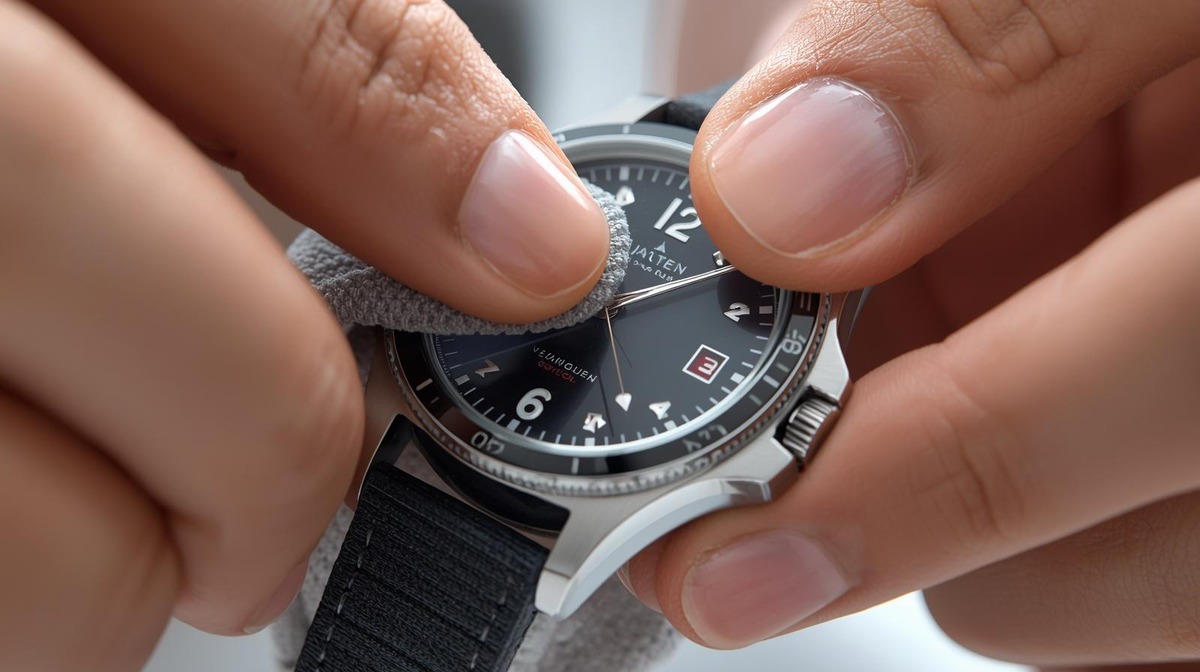
How can I clean my watch face without risking damage?
At first glance, it might seem like just a quick wipe of the glass – but in reality, it’s one of the most common mistakes, which can permanently ruin the appearance of your watch. If you want the dial to look as good as new for years to come, it’s worth knowing what to avoid at all costs and how to clean it safely – without the risk of scratches, tarnishing or costly repairs.