




Super-LumiNova vs Tritium – which lasts longer and which luminescence should you choose?
Super-LumiNova glows brighter after exposure to light, but its brightness gradually fades. Tritium glows constantly without recharging from light, remaining readable throughout the night, with a practical lifespan of approximately 20–25 years. The choice therefore depends mainly on how and when you use your watch after dark. Discover which illumination better meets your needs and choose a watch that maintains readability when you truly need it.
Super-LumiNova versus tritium – the key difference concerns the light source
Watch dial illumination is responsible for readability after dark and in low light. It typically includes hands, hour indices, or other markings on the dial. Depending on the technology used, it may require prior light exposure or work independently of external light sources.
And that's precisely what Super-LumiNova requires prior light exposure for, while tritium generates light on its own 24/7. In the first case, we're dealing with photoluminescence. The pigment absorbs energy from sunlight, artificial light, or UV, then gradually releases it as visible light. Tritium works differently. Small glass tubes contain a gaseous hydrogen isotope whose beta decay excites a phosphor coating their inner walls. The result is continuous 24/7 radioluminescence, regardless of whether the watch previously lay in the sun, under a lamp, or for many hours in a closed drawer.
This difference changes how you use a watch more than it might seem. If you enter a dark room after a full day outdoors, well-charged Super-LumiNova can glow significantly brighter than tritium. However, if after a few hours you want to check the time in complete darkness, the situation begins to reverse. Tritium continues glowing with similar intensity, while the photoluminescent pigment loses a substantial portion of its initial brightness.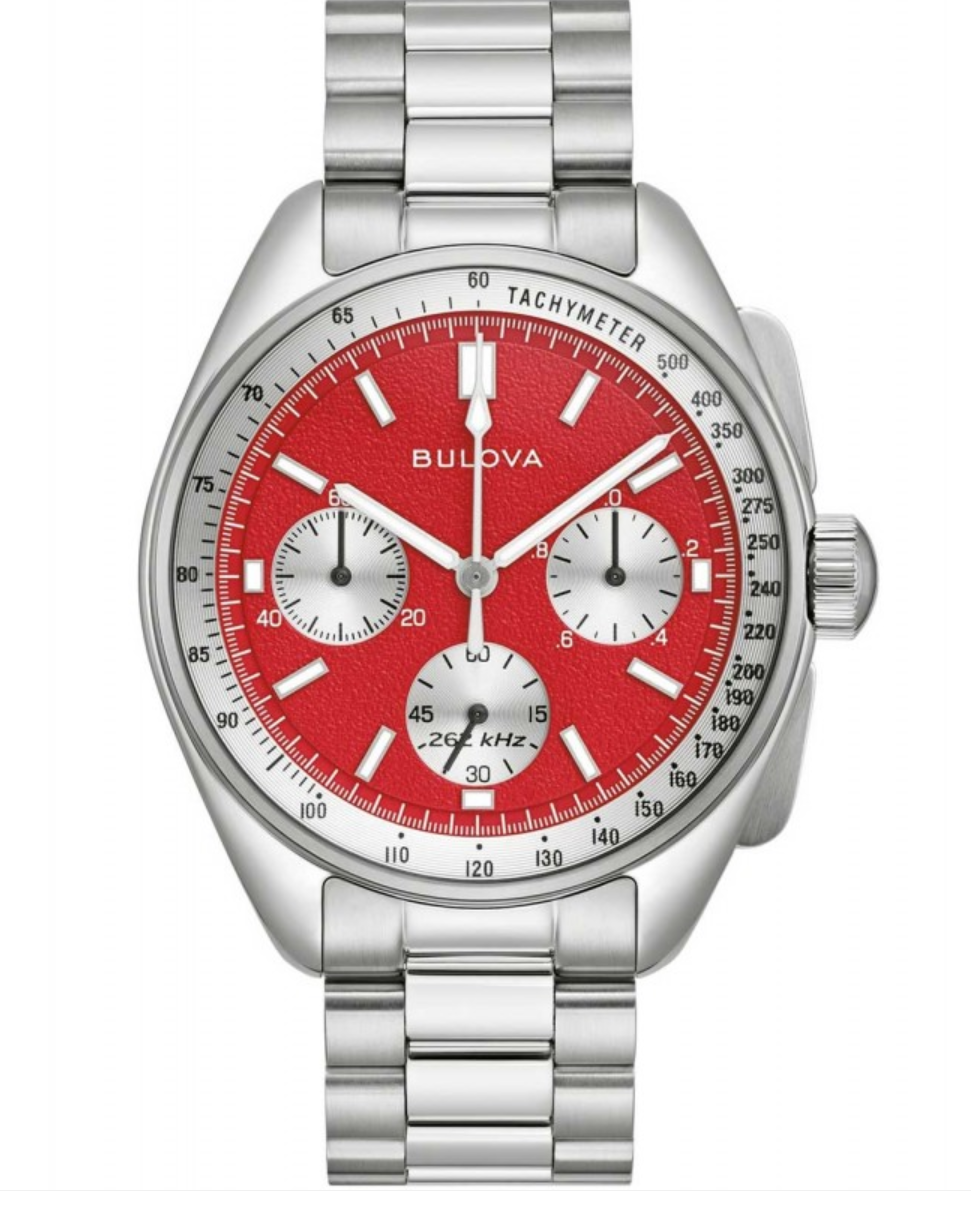
Bulova Lunar Pilot 96K115 demonstrates that good illumination can go hand in hand with distinctive design. Hands and indices are coated with luminescent material that improves readability of the red dial in dim light, completed by a precise High Precision Quartz mechanism and characteristic styling inspired by the history of space exploration.
Super-LumiNova – what is it and how long does it glow after charging?
Super-LumiNova is a non-radioactive photoluminescent pigment based on strontium aluminate that gathers energy from light and gradually releases it after darkness falls. The material is doped with rare earth elements, primarily europium and dysprosium. You can think of it as a small "light battery" placed on the dial. After the watch is exposed to light, electrons are excited to a higher energy level, then slowly return to the ground state. The light emission accompanying this is fluorescence. The material itself is non-radioactive and non-toxic.
After full charging, Super-LumiNova can glow for approximately 7–10 hours, with the highest brightness occurring in the first hours and a particularly noticeable drop after just 15–30 minutes. Better variants can work longer. According to material data, class C1 provides approximately 3–5 hours of glow, C3 – 10–14 hours, while X1 and X2 variants can exceed 16 hours. However, this doesn't mean identical brightness throughout. The glow gradually weakens, so the class designation matters when comparing two watches apparently using the same technology. The amount of pigment and its color variant also matter.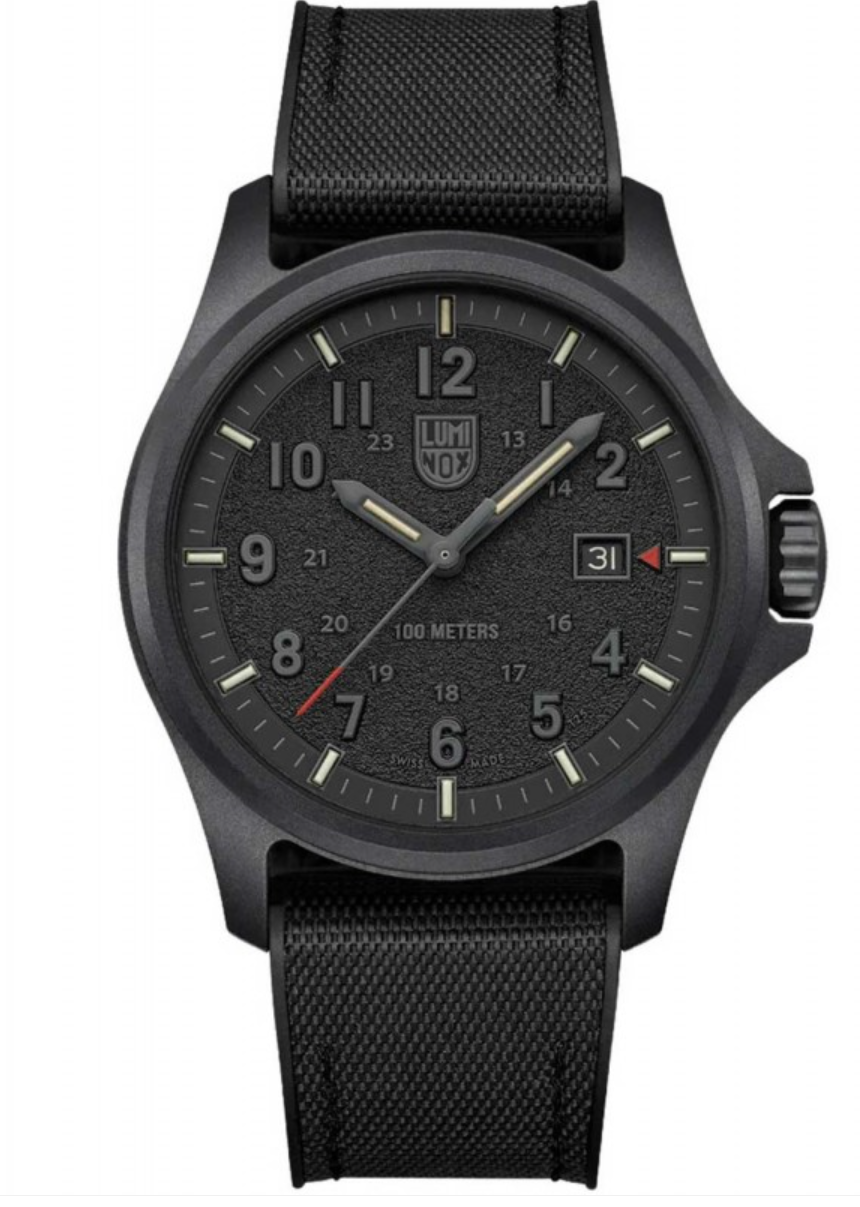
Luminox Atacama Field XL.1961 is a good example of a watch using tritium illumination. Luminox Light Technology based on tritium microtubes provides constant 24/7 visibility even for 25 years without needing to pre-charge the dial. This makes the model work well during nighttime activities and longer expeditions.
Tritium doesn't need charging – it glows even after many hours in darkness!
Tritium illumination works without access to external light, so the dial remains readable even when the watch has been in darkness for many hours. In watches, light sources known as GTLS – Gaseous Tritium Light Sources are used. Tritium is contained in hermetically sealed, tiny glass tubes whose interiors are coated with phosphor. Electrons emitted during beta decay continually excite it, so indices or hands emit light regardless of time of day. You don't need to expose the watch to sunlight or shine a flashlight on it before using it at night.
The tritium half-life is approximately 12.32–12.33 years. After roughly 12 years, the illumination is thus about 50% of initial intensity, and after approximately 25 years remains roughly 25%. The practical lifespan of the tubes is usually 20–25 years. Tritium is a radioactive material, but according to material data it emits low-energy beta radiation that doesn't penetrate skin or the glass tube walls. The designations T25 and T100 inform about tritium quantity: respectively up to 25 mCi and 100 mCi.
Tritium works well during long expeditions and nighttime activities, which is why a mountain watch with such illumination can be a practical choice when constant readability without prior charging matters.
Luminox Navy SEAL XS.3251.BO.CB uses Luminox Light Technology (LLT), which utilizes tritium microtubes and provides constant 24/7 illumination even for 25 years. This means the 45-millimeter model remains readable in complete darkness without prior charging, and 200 m water resistance underscores its practical, field-oriented character.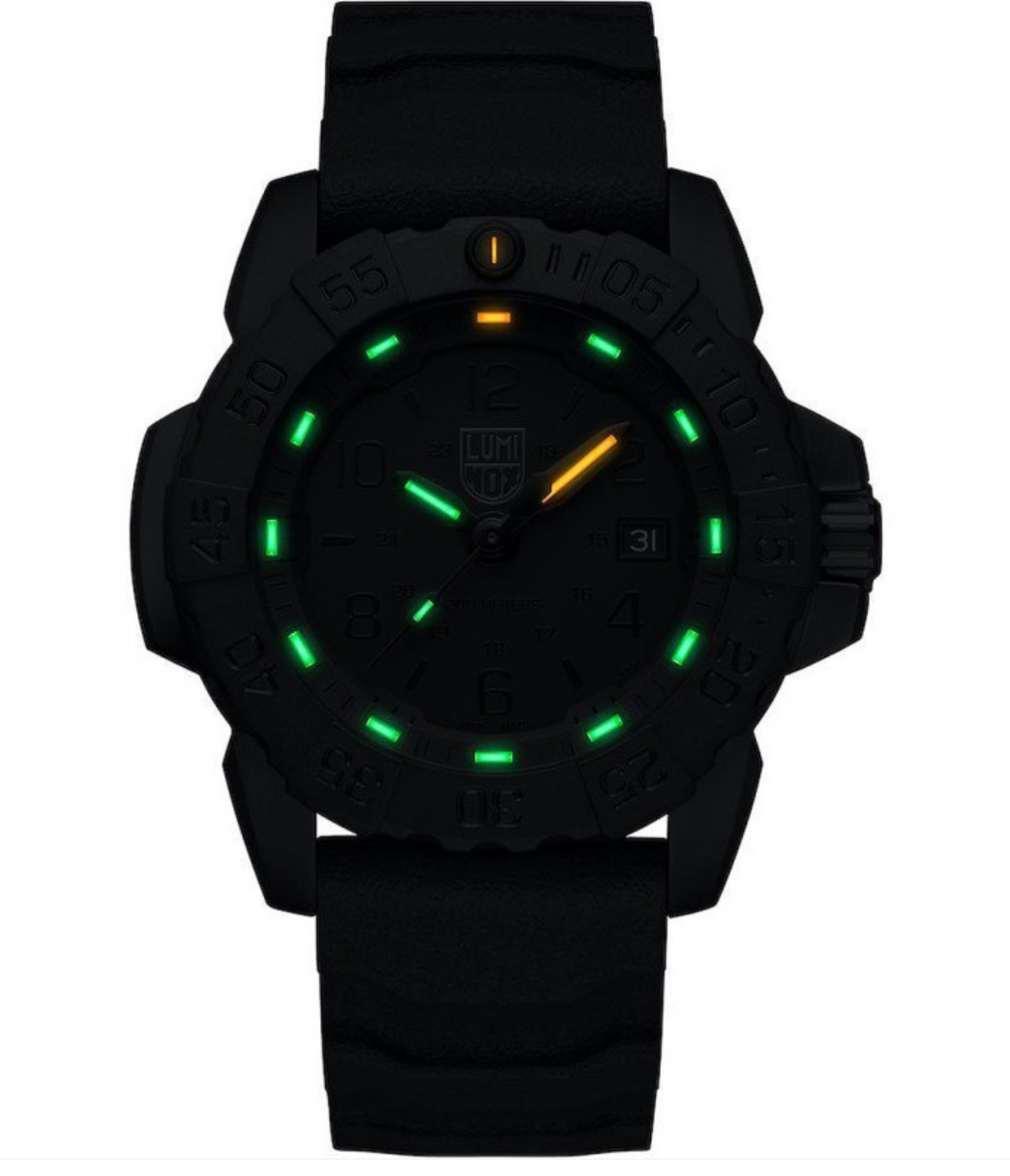
What's brighter – Super-LumiNova or tritium?
Immediately after strong exposure, Super-LumiNova is brighter, but after several hours of complete darkness, tritium may provide better readability. This is precisely why comparing both technologies based on first impression alone can lead to wrong conclusions. Freshly charged Super-LumiNova can deliver a strong, distinct glow. Tritium glows more calmly and evenly. Its advantage reveals itself over time: there's no rapid fade characteristic of photoluminescent pigment here. According to material data, after approximately 2–4 hours in complete darkness, tritium can become easier to read.
Color also matters. Popular C3 has a bright yellow appearance in daylight and glows green. Available are also, among others, the blue BGW9 variant, as well as orange and red versions. Additional dyes can, however, limit brightness. Tritium comes in fewer variants – primarily green, yellow, blue, and orange. If you care mainly about a strong visual effect when entering darkness, Super-LumiNova has the advantage. When stable time reading at 3 or 4 in the morning is more important, tritium may be more practical.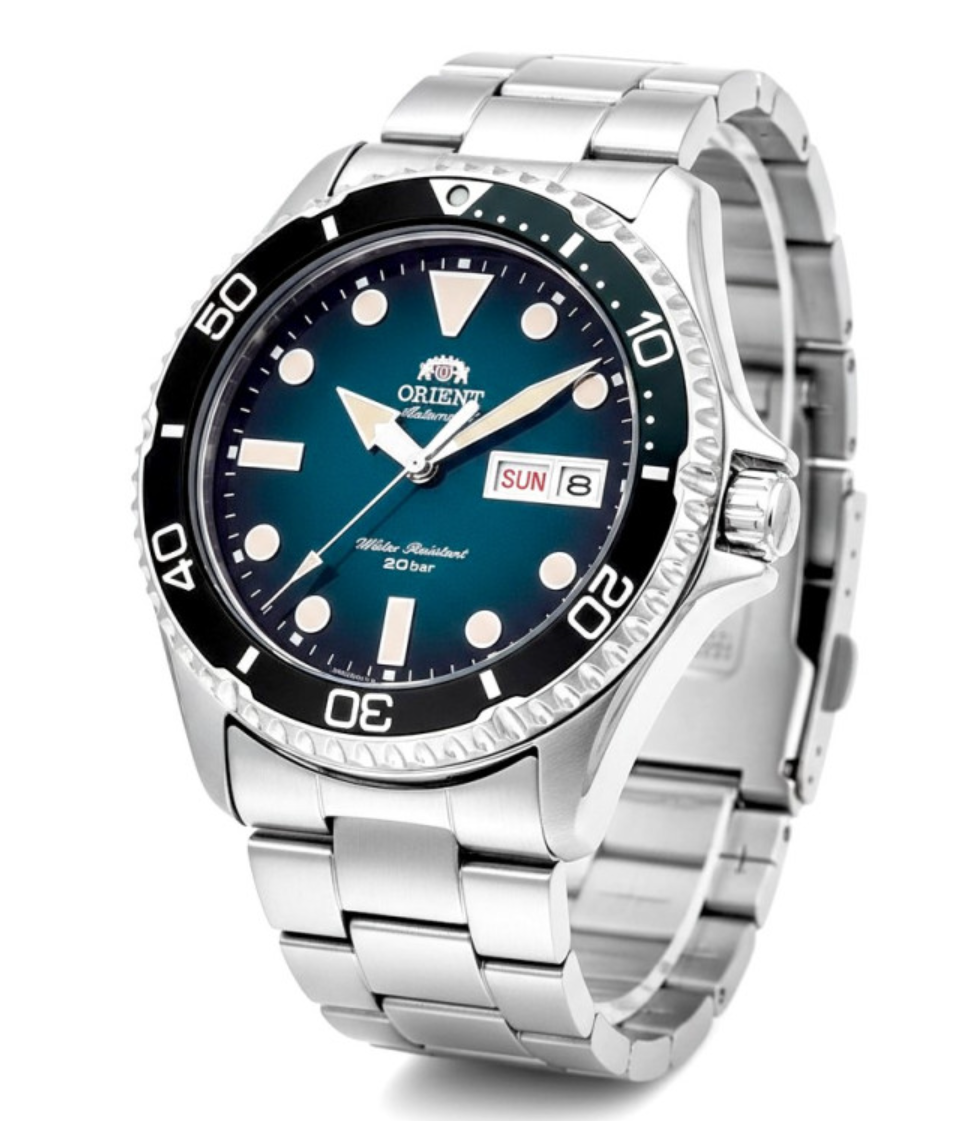
Orient Kamasu Diver Automatic RA-AA0811E39B is a sporty model where luminescent hands and indices make it easy to read the time after dark and underwater. The distinctive dial, automatic mechanism, and 200 m water resistance make it work well both for everyday wear and outdoor activities.
When to choose a dial with Super-LumiNova and when a tritium watch?
Super-LumiNova better suits everyday use and situations where the watch regularly has light contact, while tritium works where constant visibility without prior charging matters. If you wear your watch during the day, work in normally lit spaces, and want a strong glow when entering a cinema, garage, or bedroom, photoluminescent pigment will be the natural choice. It also provides greater color freedom and is widely used in everyday, sports, and luxury watches. Solutions of this type are associated with brands including Omega, Longines, Tissot, Venezianico, and U-Boat, while Seiko uses its own LumiBrite technology.
Choose tritium when you want your watch readable regardless of previous lighting conditions. This feature is especially valuable in tactical, diving, and professional watches used at night or for extended periods in darkness. Solutions associated with GTLS include Ball Watch, Traser, Luminox, and select models from Vostok Europe. When purchasing, don't limit yourself to asking "does the dial glow?" Check how it glows, how long it maintains readability, and whether it requires charging. Super-LumiNova offers a stronger start and greater styling freedom. Tritium wins through independence from light and constant visibility for many years. In practice, the best choice depends on when you'll most often read the time in darkness.
Watch dial illumination has a major impact on its readability after dark and in dim light – so it's worth choosing a model suited to your needs. In the WestWatches online watch store you'll find a wide selection of men's watches and women's watches matched to different needs, styles, and budgets.

Krzysztof Szopa
Watch Expert
Expert associated with the WestWatches.pl brand, a place that has been supplying watches for every occasion for years. Thanks to many years of experience in the watchmaking and jewelry industry, he passionately shares his knowledge, offering professional advice both in the online store and in the physical location. He specializes in selecting original watches, watch accessories, and jewelry items that combine exceptional quality with competitive prices. His goal is to help customers find the perfect product that meets their expectations and highlights their style.

See popular articles

316L, 904L and surgical steel – what is your watch made of?
Most steel watches, from affordable models to luxury constructions, are made of 316L steel. 904L steel contains more nickel, chromium and molybdenum, and therefore offers higher corrosion resistance, but in itself it does not mean greater scratch resistance. The term “surgical steel”, in turn, does not point to one strictly defined alloy. In watches it most often refers to 316L, but without a specific material designation it may simply be a marketing name. If you are choosing a watch for years, look therefore not only at the words “stainless steel”, but also at the grade of steel, which components are made of the given material and how they are finished.
Japanese or Swiss watches? We compare quality, movements and prices
If you are wondering whether Japanese or Swiss watches are better, the name of the country alone will not give you a good answer. In both cases you will find simple models for relatively little money, solid mid-range automatics and designs belonging to the world's watchmaking high end. Far more about quality will be told to you by the specific movement, the way the case and bracelet are made, the crystal, quality control, accuracy and price. Check how Japanese watches really differ from Swiss ones and what to pay attention to before you choose a model for yourself.

The lifespan of a quartz watch – how long does it really last, and when is it no longer worth repairing?
We value quartz watches above all for their accuracy, convenience and modest day-to-day demands. That does not mean, however, that they can run indefinitely and need nothing more than a new battery once every few years. Over time, the components of the movement itself also wear out, and the moment a watch starts giving trouble can look completely different depending on the model, the way it is used and the availability of parts. So how long can a quartz watch last, what wears out in it most often and when does repair still make sense? Check what its lifespan really depends on.

The second hand on a watch – why does it jump, move smoothly or stop?
The way the seconds hand moves can tell you a lot about a watch's movement, but it is not an infallible test. A single distinct jump per second most often points to quartz, several small movements per second are typical of a mechanical movement, and an almost continuous glide is associated with Spring Drive. There are exceptions, however: there is a quartz watch with a sweeping seconds hand, and a mechanical watch that makes exactly one jump per second. What is more, a stopped hand does not have to mean a fault. Check how to read these signals and when you really need a watchmaker's help.

How do you set an automatic watch? Date, time and time zone 21:00–3:00
An automatic watch does not need a battery, but it does require a little knowledge from its owner. Setting the time or date seems simple, yet the wrong moment or the wrong way of using the crown can affect how the movement works. Many questions concern changing the date at night, moving the hands backwards and restarting a watch after a longer break. Check how to set an automatic watch correctly, what to pay attention to with the crown and why people often talk about particular caution between 9:00 pm and 3:00 am.

Wodoszczelność 10 ATM i 20 ATM – czy możesz pływać i nurkować z takim zegarkiem?
Co naprawdę oznacza 10 ATM lub 20 ATM na zegarku i czy takie oznaczenie pozwala bez obaw wejść do basenu, morza albo nurkować? Same liczby mogą być mylące, dlatego sprawdź, jak czytać klasę wodoszczelności i dobrać zegarek do aktywności w wodzie.

Water resistance 3 ATM – what does it mean and what can you do with it?
3 ATM water resistance means the watch is prepared above all for rain, accidental splashes and brief contact with water during everyday activities. It does not mean that you can swim with it, shower in it or submerge it to a depth of 30 metres. It is precisely the “30 m” marking that most often misleads. It is the result of a pressure test carried out under controlled conditions, not a declared working depth. So if you see 3 ATM, 3 bar or Water Resistant 30 m on the case back or in the specification, treat the watch as resistant to everyday moisture, but not as a watch for water activities.

Rolex-style watches – the best alternatives to the Submariner, Explorer and Datejust
For years Rolex has been one of the most important style benchmarks in the watch world, but its price is not within everyone's reach. That is why it is worth looking at watches similar to Rolex and models inspired by its styling, which offer their own character, solid build quality and much more affordable prices. We are not talking about counterfeits here, but about legitimate watches from other brands that draw on similar solutions and design language. Check out watches inspired by Rolex's style and choose the model that suits your style and budget.
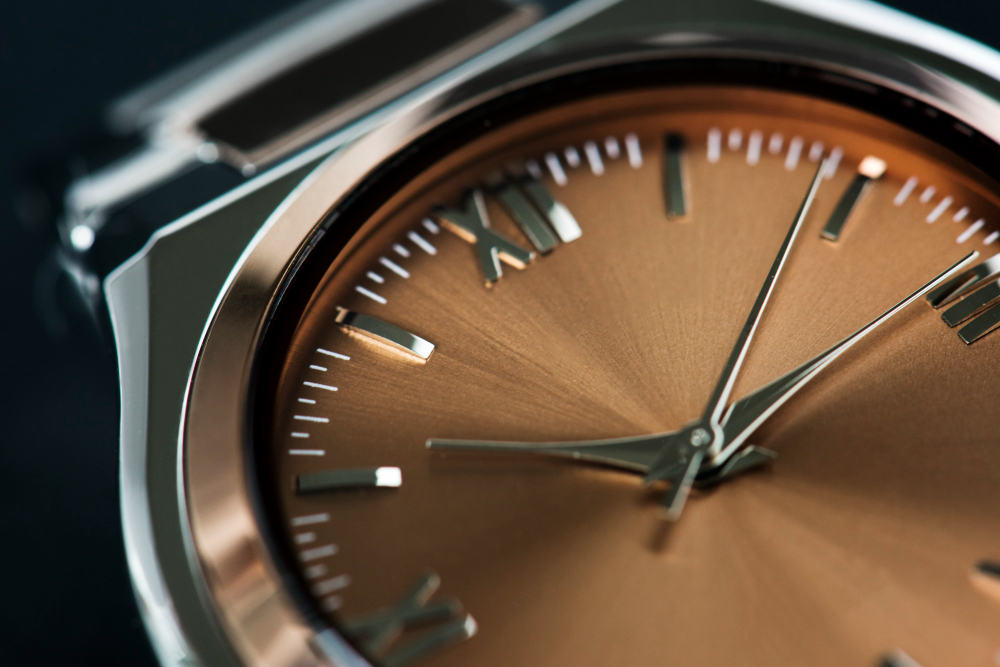
A bronze watch – why does each one change over time?
A bronze watch stands out because its appearance changes along with its owner. The case gradually darkens, turns matte and develops a patina, so two identical models can look completely different after just a few months. This is the greatest advantage of bronze, but also a trait you need to accept before buying. If you expect a watch that keeps its factory shine for years, steel may be a better direction. If, on the other hand, you like vintage looks, signs of use and the natural ageing of a material, bronze gives an effect that is hard to achieve in any other metal.