



The logarithmic slide rule on an aviator’s watch – how do you use it?
A slide rule in a watch is a mechanical calculator that lets you multiply, divide and convert time, distance, speed and fuel consumption. Although the dense scale on the dial may look decorative, in aviation watches it serves a practical purpose. Find out how the slide-rule bezel works and how to use it for everyday calculations.
What is a slide rule in an aviation watch?
It is a system of two logarithmic scales that move relative to each other, most often placed on the dial and the rotating bezel of the watch. One scale stays fixed, while you rotate the other using the bezel or an additional crown.
The distances between the markings are not equal. They result from the values of logarithms, so that physically shifting a scale replaces doing the arithmetic on paper. Multiplication is turned into adding distances, while division becomes subtracting them. The reference point is usually the marking 10. However, it does not stand only for the number ten. Depending on the operation, it can also represent 1, 100, 1000 or 0.1. The slide rule shows the digits of the result, but you have to determine its actual order of magnitude yourself.
In simpler terms: a slide rule is a small mechanical calculator built into a watch. By rotating one scale relative to the other, you can quickly perform basic calculations, such as multiplication, division or unit conversion, without using a calculator. 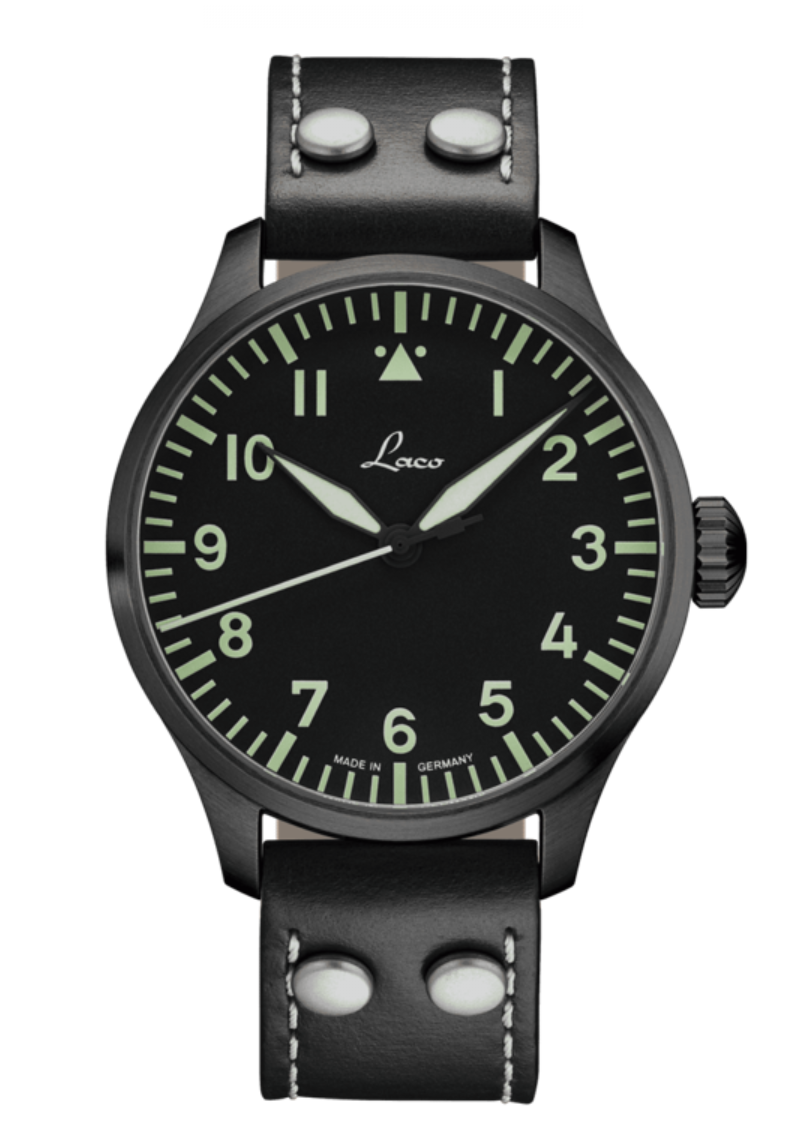
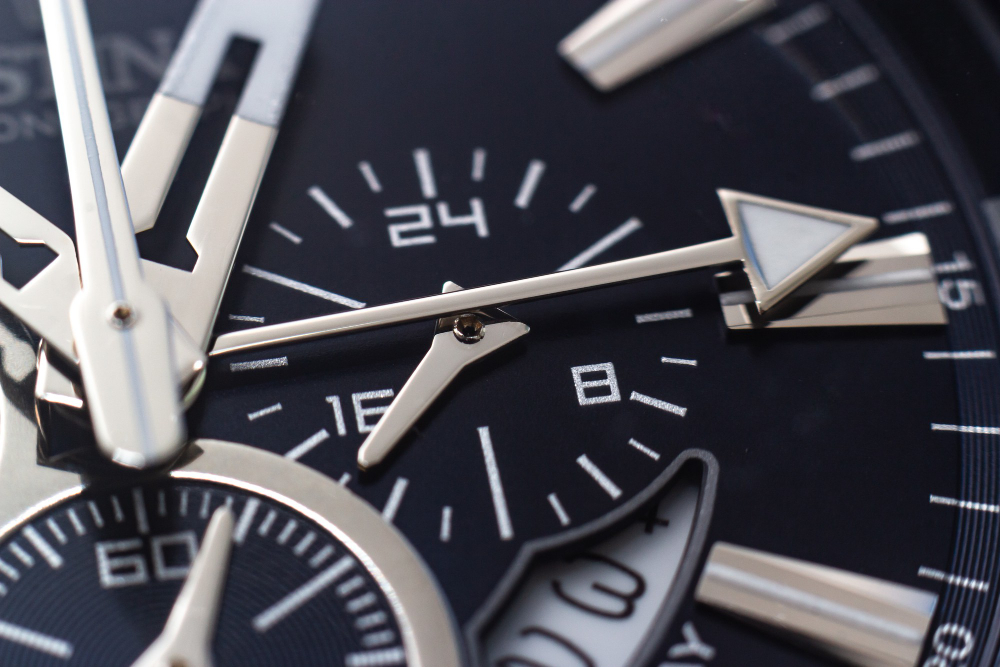
LACO Altenburg Automatic 42 mm 861759.2 is a striking aviation watch inspired by classic pilot timepieces. The black dial with large, legible indexes, the characteristic triangle at 12 o'clock and the riveted leather strap emphasise its military style, while the automatic movement and the 42 mm case make the model a great functional men's watch for everyday wear.
What is a slide-rule bezel used for?
A slide-rule bezel lets you perform basic calculations such as multiplication, division and finding proportions. It can also be used to calculate speed, flight time and fuel consumption.
The scales also help convert units of distance, volume and mass, for example miles to kilometres, gallons to litres and pounds to kilograms. Depending on the model, the arrangement of the inner and outer scale may be reversed.
It is worth pointing out that a slide-rule bezel is not the same as a tachymeter. A slide rule is used for multiplication, division, finding proportions and converting units, whereas a tachymeter works together with a chronograph and lets you calculate average speed. The chronograph itself measures short intervals of time, while an ordinary rotating bezel helps you keep track of the time that has elapsed or remains.
Where did the slide-rule bezel come from?
The slide-rule bezel came to watches as a miniature version of the technical calculating slide rule. Before electronic calculators became commonplace, slide rules were used by engineers, navigators and people doing calculations in the field.
Breitling patented a chronograph with a circular slide rule as early as around 1940, and in 1942 it applied this solution in the Chronomat model. In 1952 the Navitimer was created, developed for the Aircraft Owners and Pilots Association. The manufacturer describes it as the first wrist-worn aviation computer equipped with a patented circular slide rule allowing calculations to be made during flight.
Who might find a slide rule useful?
A slide rule is most often found in aviation watches, because it was originally used by pilots to make quick calculations during flight. Among other things, it allowed them to estimate speed, flight time, fuel consumption and to convert units of distance, mass and volume.
Today it can be useful not only to pilots, but also to enthusiasts of aviation, technology and traditional mechanical watches. It is a practical tool for people who want to perform simple calculations without a calculator, while also appreciating the functional and distinctive look of the watch.
This does not mean, however, that every flieger has a slide-rule bezel. Classic aviation watches of type A and type B were designed primarily for reading the time at a glance. Type A has a simple hour scale, whereas type B stands out with a large minute scale on the outside and a smaller hour ring in the centre. Their dials can be very minimalist and free of additional complications.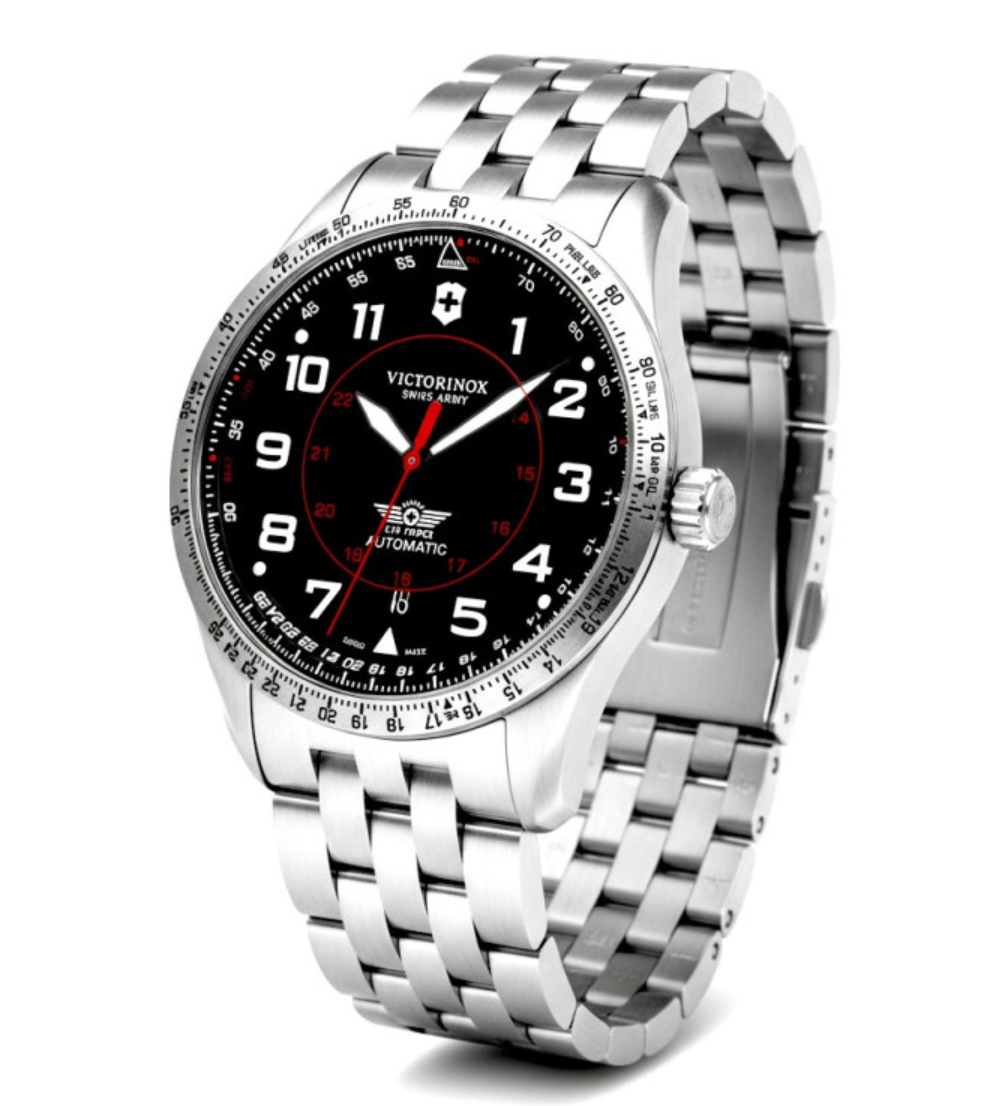
Victorinox Airboss Automatic 42 mm 241888 is an aviation watch that combines a bold look with a practical slide rule. The extensive scales on the dial and bezel let you perform basic calculations and convert units, referencing the traditional tools used by pilots. The automatic movement, legible dial and steel bracelet emphasise the technical character of this men's watch.
How to calculate with a slide rule step by step?
You perform a basic operation by setting one value against the index 10 and then reading off the result at the second value. The exact direction of rotation depends on the design of the watch, since in some models the movable scale is on the outside and in others on the inside of the dial.
How to multiply?
Let's say you want to calculate 20 × 15:
- set 20 on the outer scale opposite 10 on the inner scale,
- find 15 on the inner scale,
- read the corresponding 30 on the outer scale,
- determine the order of magnitude – the result is 300.
The scale shows 30, not 300, because the slide rule does not automatically set the decimal point. You can easily check this with an estimate: 20 times 15 must give a value greater than 200, so the correct reading is 300, not 30 or 3000. The same example appears in Citizen's official manual for the calculation functions.
How to divide?
For the operation 250 ÷ 20:
- set 25 on the outer scale opposite 20 on the inner scale,
- find the index 10 on the inner scale,
- read 12.5 on the outer scale.
The result is 12.5. When dividing, you therefore set the dividend opposite the divisor and look for the answer at the index 10.
How to calculate a proportion?
The slide rule can also solve the equation 30/20 = 60/x:
- set 30 opposite 20,
- find 60 on the first scale,
- read 40 on the second.
You get x = 40. Once the scales are set, the same proportion is kept around the entire circumference, so you can also read off other corresponding values.
|
Operation |
Scale setting |
Reading |
|
20 × 15 |
20 opposite 10 |
at 15 read 30, i.e. 300 |
|
250 ÷ 20 |
25 opposite 20 |
at 10 read 12.5 |
|
30/20 = 60/x |
30 opposite 20 |
at 60 read 40 |
At first, rotate the bezel slowly and check the result with an ordinary calculator. After a few tries you will notice that using the slide rule relies on one repeatable pattern, rather than on memorising many separate procedures.
What is a slide rule useful for and how to choose the right watch?
A slide rule is useful for quick proportional calculations, but today its greatest advantage is combining a real function with the technical character of the watch. It does not replace avionics or professional flight planning, yet it can still serve as a handy calculator and a practice tool.
In a pilot's watch, a slide rule can be used to calculate the time needed to cover a given distance, the distance travelled at a given speed, average fuel consumption and the amount of fuel needed for a given time. It also lets you convert nautical miles to kilometres, work out proportions and perform simple operations useful in everyday life. 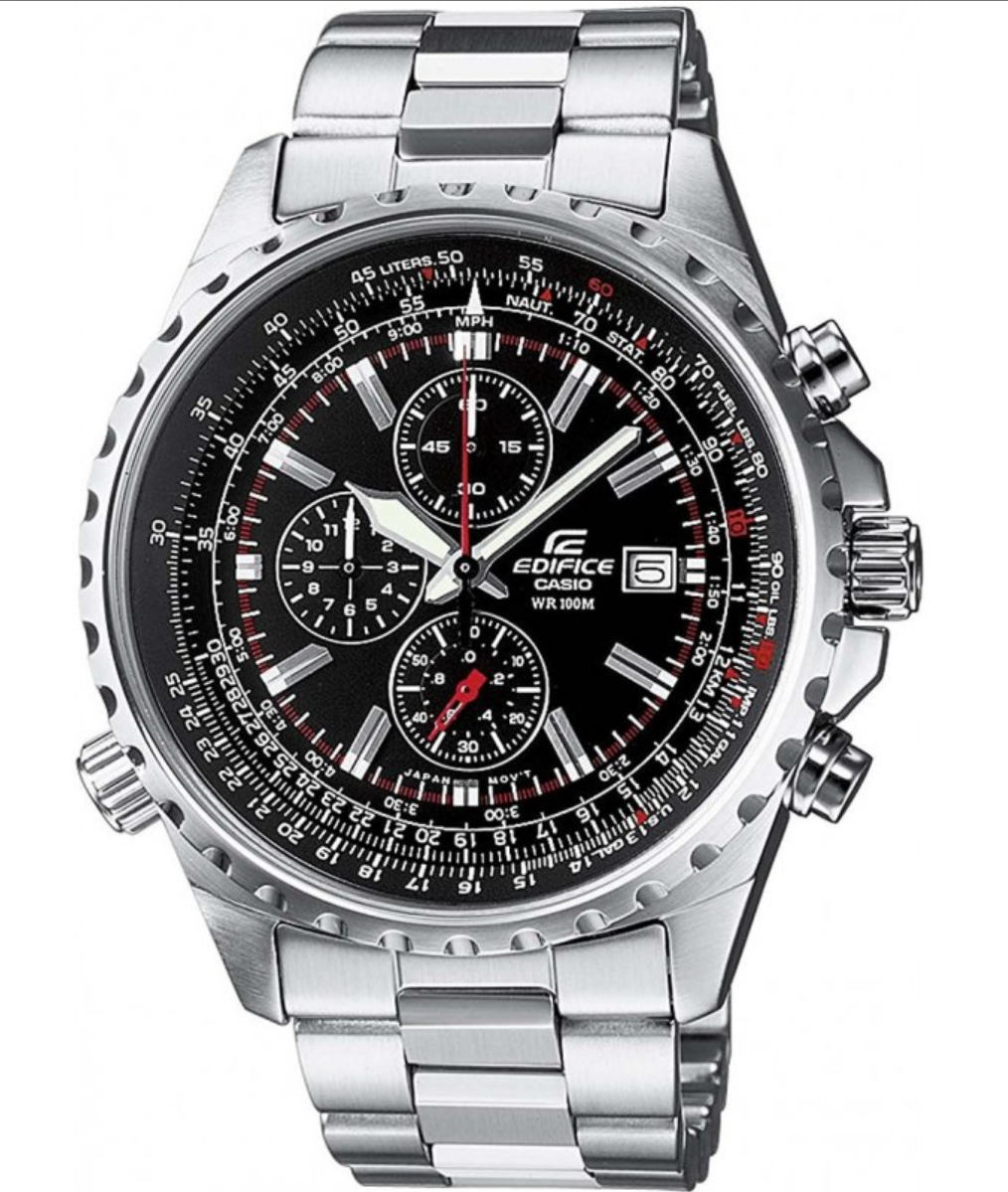
An example of a modern watch with such a function is the Casio Edifice EF-527D. The model combines a rotating slide rule with a chronograph measuring time to 1/20 of a second, a steel case and water resistance to 100 metres. The manufacturer notes that it can perform calculations relating to time, speed and fuel consumption.
A slide rule is a solution that combines a practical use with the distinctive style of aviation watches. It is worth paying attention to when choosing functional men's watches for lovers of technology, precision and classic design. The online watch shop WestWatches offers models with a variety of purposes, so you can find a timepiece suited both to everyday use and to more specialised needs.

Krzysztof Szopa
Watch expert
An expert associated with the WestWatches.pl brand, a place that has been supplying watches for every occasion for years. Thanks to many years of experience in the watchmaking and jewellery industry, he passionately shares his knowledge, offering professional advice both in the online shop and in the brick-and-mortar store. He specialises in selecting original watches, watch accessories and jewellery that combine exceptional quality with competitive prices. His goal is to help customers find the perfect product that meets their expectations and highlights their style.

See popular articles

316L, 904L and surgical steel – what is your watch made of?
Most steel watches, from affordable models to luxury constructions, are made of 316L steel. 904L steel contains more nickel, chromium and molybdenum, and therefore offers higher corrosion resistance, but in itself it does not mean greater scratch resistance. The term “surgical steel”, in turn, does not point to one strictly defined alloy. In watches it most often refers to 316L, but without a specific material designation it may simply be a marketing name. If you are choosing a watch for years, look therefore not only at the words “stainless steel”, but also at the grade of steel, which components are made of the given material and how they are finished.
Japanese or Swiss watches? We compare quality, movements and prices
If you are wondering whether Japanese or Swiss watches are better, the name of the country alone will not give you a good answer. In both cases you will find simple models for relatively little money, solid mid-range automatics and designs belonging to the world's watchmaking high end. Far more about quality will be told to you by the specific movement, the way the case and bracelet are made, the crystal, quality control, accuracy and price. Check how Japanese watches really differ from Swiss ones and what to pay attention to before you choose a model for yourself.

The lifespan of a quartz watch – how long does it really last, and when is it no longer worth repairing?
We value quartz watches above all for their accuracy, convenience and modest day-to-day demands. That does not mean, however, that they can run indefinitely and need nothing more than a new battery once every few years. Over time, the components of the movement itself also wear out, and the moment a watch starts giving trouble can look completely different depending on the model, the way it is used and the availability of parts. So how long can a quartz watch last, what wears out in it most often and when does repair still make sense? Check what its lifespan really depends on.

The second hand on a watch – why does it jump, move smoothly or stop?
The way the seconds hand moves can tell you a lot about a watch's movement, but it is not an infallible test. A single distinct jump per second most often points to quartz, several small movements per second are typical of a mechanical movement, and an almost continuous glide is associated with Spring Drive. There are exceptions, however: there is a quartz watch with a sweeping seconds hand, and a mechanical watch that makes exactly one jump per second. What is more, a stopped hand does not have to mean a fault. Check how to read these signals and when you really need a watchmaker's help.

How do you set an automatic watch? Date, time and time zone 21:00–3:00
An automatic watch does not need a battery, but it does require a little knowledge from its owner. Setting the time or date seems simple, yet the wrong moment or the wrong way of using the crown can affect how the movement works. Many questions concern changing the date at night, moving the hands backwards and restarting a watch after a longer break. Check how to set an automatic watch correctly, what to pay attention to with the crown and why people often talk about particular caution between 9:00 pm and 3:00 am.

Wodoszczelność 10 ATM i 20 ATM – czy możesz pływać i nurkować z takim zegarkiem?
Co naprawdę oznacza 10 ATM lub 20 ATM na zegarku i czy takie oznaczenie pozwala bez obaw wejść do basenu, morza albo nurkować? Same liczby mogą być mylące, dlatego sprawdź, jak czytać klasę wodoszczelności i dobrać zegarek do aktywności w wodzie.
Water resistance 3 ATM – what does it mean and what can you do with it?
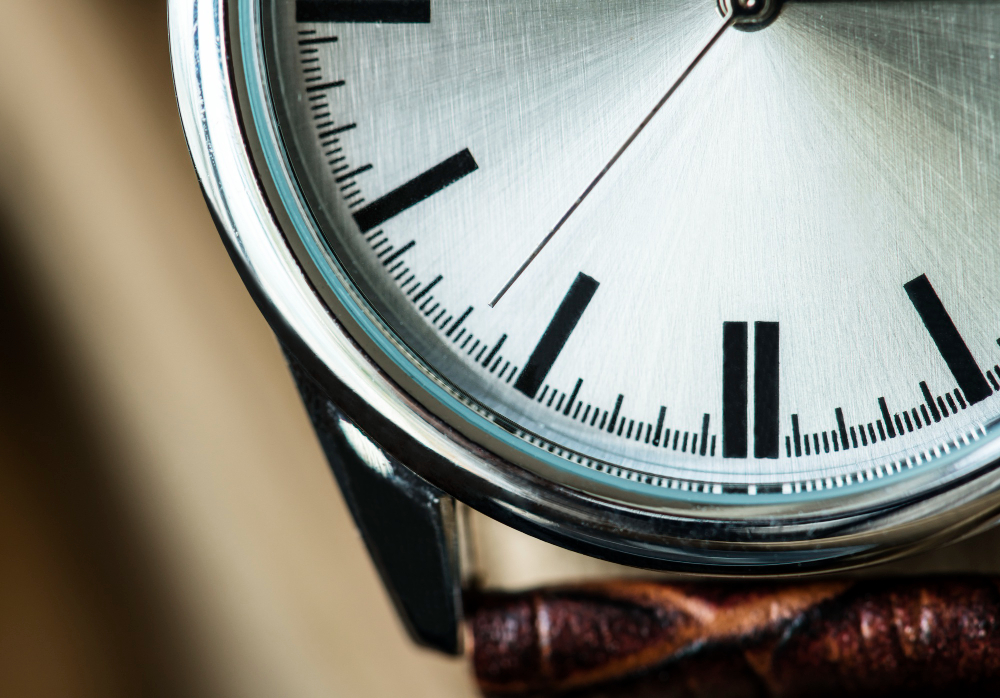
3 ATM water resistance means the watch is prepared above all for rain, accidental splashes and brief contact with water during everyday activities. It does not mean that you can swim with it, shower in it or submerge it to a depth of 30 metres. It is precisely the “30 m” marking that most often misleads. It is the result of a pressure test carried out under controlled conditions, not a declared working depth. So if you see 3 ATM, 3 bar or Water Resistant 30 m on the case back or in the specification, treat the watch as resistant to everyday moisture, but not as a watch for water activities.

Rolex-style watches – the best alternatives to the Submariner, Explorer and Datejust
For years Rolex has been one of the most important style benchmarks in the watch world, but its price is not within everyone's reach. That is why it is worth looking at watches similar to Rolex and models inspired by its styling, which offer their own character, solid build quality and much more affordable prices. We are not talking about counterfeits here, but about legitimate watches from other brands that draw on similar solutions and design language. Check out watches inspired by Rolex's style and choose the model that suits your style and budget.
A bronze watch – why does each one change over time?
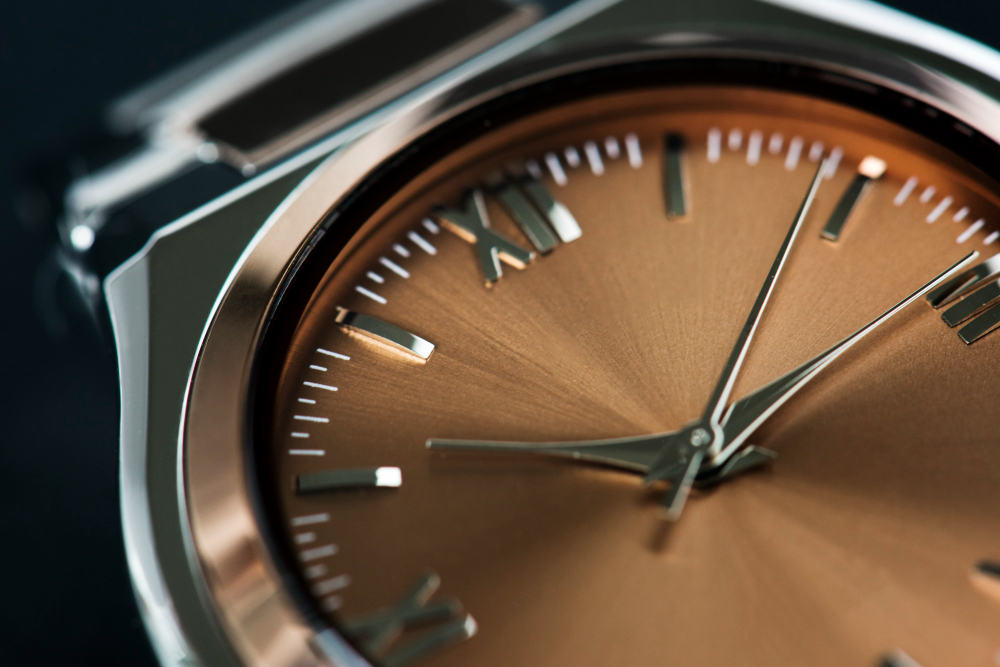
A bronze watch stands out because its appearance changes along with its owner. The case gradually darkens, turns matte and develops a patina, so two identical models can look completely different after just a few months. This is the greatest advantage of bronze, but also a trait you need to accept before buying. If you expect a watch that keeps its factory shine for years, steel may be a better direction. If, on the other hand, you like vintage looks, signs of use and the natural ageing of a material, bronze gives an effect that is hard to achieve in any other metal.