



How do you set up a watch winder? Selecting the TPD, direction and operating cycles
Do you own a beautiful automatic watch that sits in a drawer and stops every few days, forcing you to reset the time, date and complications all over again? A watch winder solves this problem once and for all – provided you set it up correctly. The wrong TPD or rotation direction will mean your watch won't wind at all, even though the device is running. In this guide we show you, step by step, how to choose the number of turns per day, the direction and the working cycles so that your timepiece is always ready to wear.
How does a programmable watch winder differ from a standard one?
Watch winders perform one key function: they keep the mechanism of an automatic watch in constant motion, which prevents the mainspring from running down and avoids problems with restarting. For watches with complications – a perpetual calendar, chronograph or moon phase indicator – regular movement is essential to keep all functions running precisely.
Not all devices, however, are created equal. Traditional, standard watch winders usually offer just a few fixed rotation settings – this works for simple mechanisms, but can be insufficient for more complex calibres.
This is where the programmable watch winder comes in. Thanks to electronic control, it lets you precisely tailor three parameters to the needs of a specific watch:
- the number of turns per day (TPD) – usually in the range of 600–1950,
- rotation direction – clockwise (CW), counter-clockwise (CCW) or alternating (bi-directional),
- working and rest cycles – the watch doesn't spin non-stop, only at scheduled intervals.
By investing in a programmable model, you gain the assurance that the mechanism is wound exactly as it needs to be – not too little and not too much. If you are still choosing a device, start with the guide on which watch winder to buy, and if you want to understand the basics, check out what a watch winder actually is.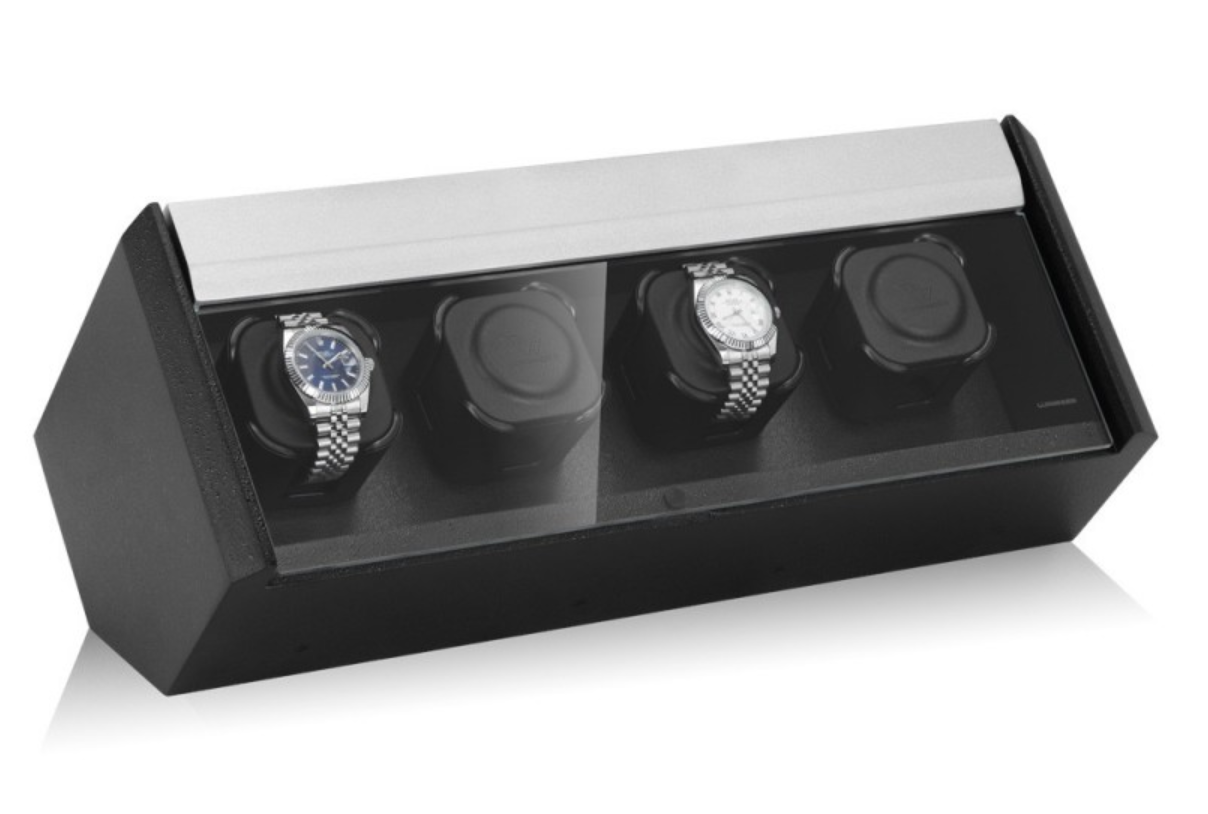
The Modalo Carat Watch Winder 2204114 is an elegant way to store and simultaneously keep up to four automatic watches in motion, so they are always ready to wear. Its modern form, quiet operation and striking glazed construction mean this model perfectly highlights the prestige of any timepiece collection.
How many turns per day (TPD) does your watch need?
TPD (Turns Per Day) is the total number of full rotations the watch winder performs over a 24-hour period. It is the most important parameter – too low and it won't wind the mainspring, too high and it needlessly stresses the mechanism.
The golden rule: if you don't know the exact specification, set 750 TPD in alternating mode – this is a safe value for the vast majority of automatic watches. You'll find the exact data for your model in the manufacturer's manual or in online TPD databases. Remember that TPD is achieved through a combination of rotations and rest – the watch winder doesn't spin continuously, but performs a programmed number of rotations spread across the day.
How much TPD your watch actually needs is also affected by the efficiency of the mechanism itself and the condition of the mainspring. Older calibres, or those serviced years ago, can be less efficient and may require values closer to the upper end of the range to maintain a full power reserve. If, after a day in the winder, you notice the watch running slow or stopping, raise the TPD by one step (usually by 50–100 turns) and observe the effect over the next 2–3 days. It's better to adjust this value gradually than to set the maximum right away — the goal is a full wind with the least possible strain on the mechanism.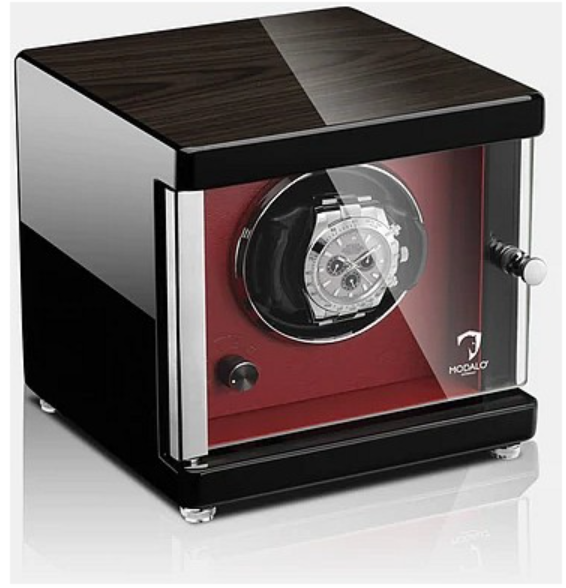
The Modalo Ambiente Watch Winder 1501744 is a luxurious single-watch winder that combines an elegant piano-lacquer finish with exceptionally quiet operation and striking LED lighting. Thanks to its advanced winding programmes and high-quality construction, it is not only a practical accessory but also a stylish display for a treasured timepiece.
Rotation direction – why does it matter?
This is the point most often overlooked, yet it can determine whether the watch winds at all. Automatic mechanisms fall into three types based on how the rotor winds them:
- Bi-directional – they wind as the rotor turns in both directions. This covers most modern calibres (ETA, Sellita, Omega). Works with any direction setting.
- Uni-directional – they wind only when the rotor turns in one direction. Setting the wrong direction means the watch will not wind at all, even though the winder is running.
- Alternating – the safest universal setting.
A classic example is the chronograph based on the Valjoux/ETA 7750 – one of the most popular chronograph calibres in the world. It winds uni-directionally (clockwise, CW). If you set the winder to the opposite direction (CCW), the rotor will spin, but the mainspring won't be wound. The same applies to some Panerai calibres. The takeaway: for watches with a uni-directional calibre, first check the required direction, and only then the TPD. For all the rest, alternating mode is a safe choice.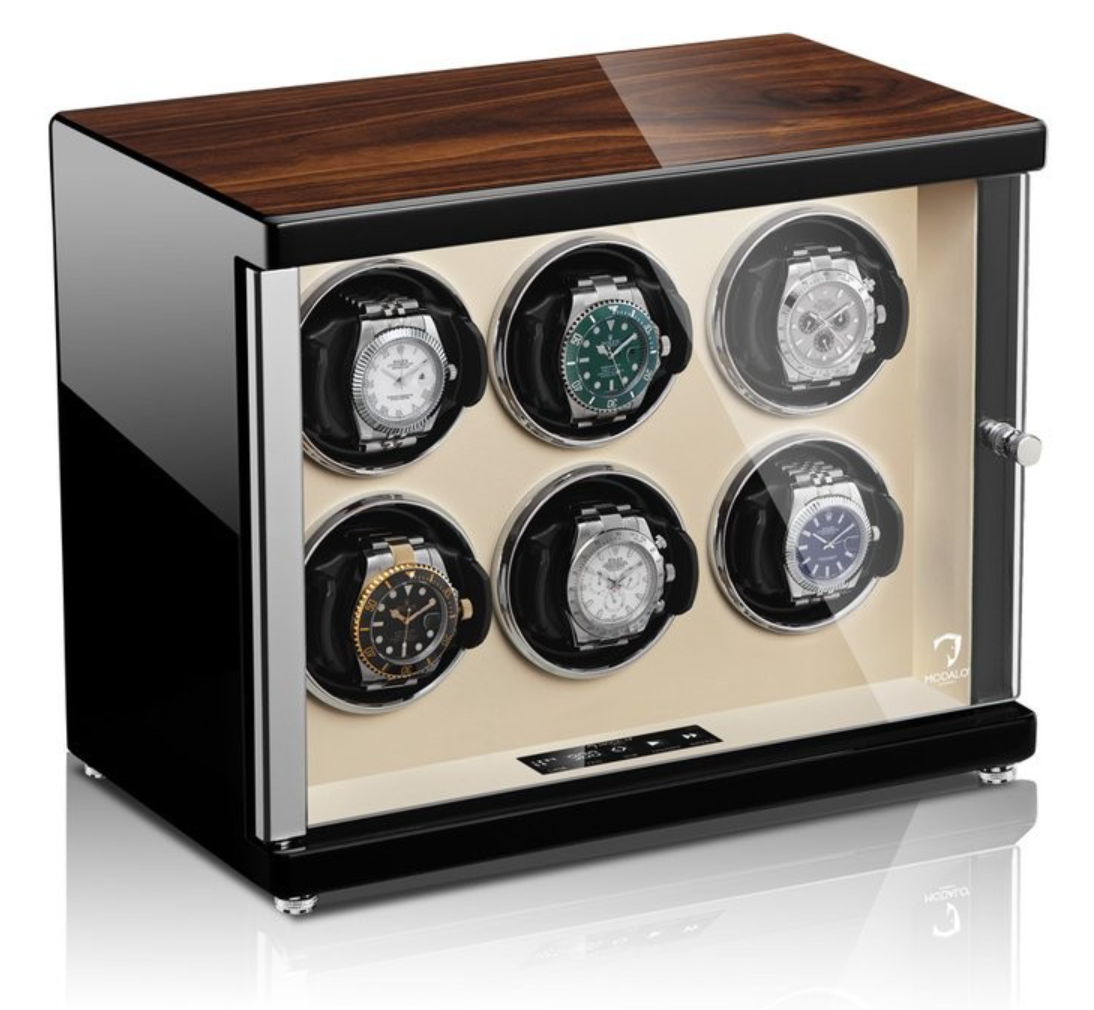
The Modalo Ambiente LCD Watch Winder 1506924 is an exclusive winder designed for six automatic watches, fitted with an intuitive LCD display that allows precise setting of the working programmes. The combination of a lacquered housing, elegant wood-tone finish and glazed doors makes it a striking and secure display for a collection of luxury timepieces.
Can you "over-wind" a watch in a winder?
No – a properly designed automatic watch cannot be "over-wound" or damaged by excess winding. Modern mechanisms have a slipping clutch which, once the mainspring is fully wound, disengages any further transfer of energy. It's the same mechanism that protects the watch on the wrist of a very active person.
So where does the concern come from? It stems from two real risks that are genuinely worth avoiding:
- Unnecessary wear – keeping a watch in motion 24/7 at too high a TPD doesn't "over-wind" it, but it increases wear on the lubricant and parts. That's why programmable winders have rest cycles.
- Wrong direction – this won't damage the watch, but it will mean it doesn't wind at all (see the section above).
In short: a sensibly configured winder (correct TPD + rest cycles) is completely safe and there is no risk of "over-winding".
A watch winder for watches with complications – chronograph, calendar, moon phase
For watches with multi-function complications, a winder stops being a convenience and becomes a practical necessity. Manually setting a perpetual calendar or moon phase indicator after every time the watch stops is time-consuming and risky. With some mechanisms, setting within the wrong time window risks damage. That's why, for such watches, it's worth choosing a programmable, good-quality winder to help maintain the correct values:
- chronograph – check the winding direction (e.g. the aforementioned 7750 requires CW),
- perpetual / annual calendar – keeping it in constant motion saves the tedious reprogramming of the date,
- moon phase – the indicator stays synchronised without manual corrections.
Pay attention to build quality too: solid, quiet motors, soft cushions that won't scratch the case, and a housing made of durable materials (wood, leather, steel). A quiet mechanism matters if the winder sits in a bedroom or office. Renowned manufacturers such as Wolf, Buben & Zorweg, Orbita and Modalo offer a guarantee of quality here.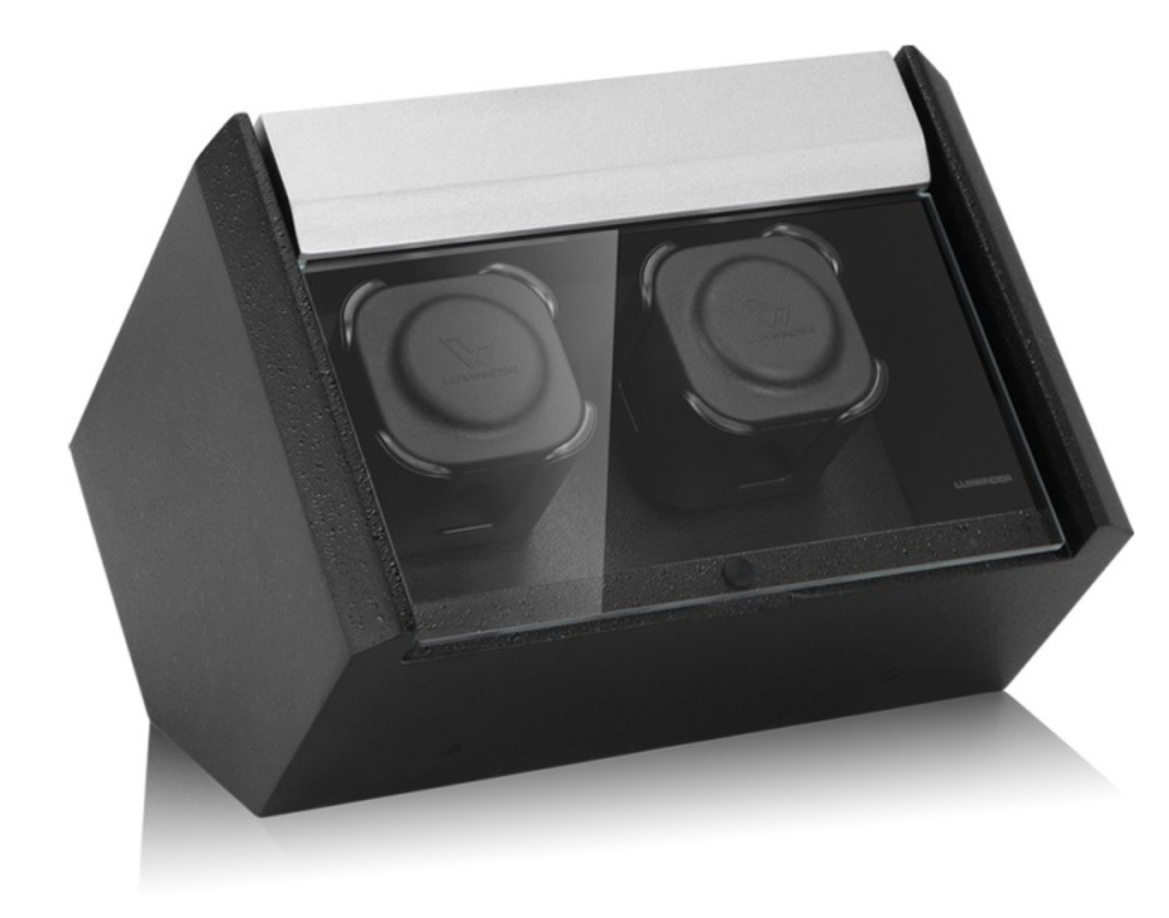
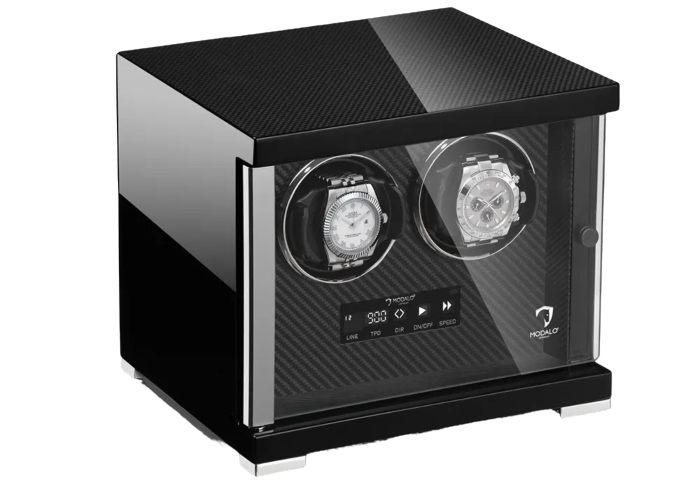
The Modalo Carat Watch Winder 2202114 is an elegant two-watch winder that impresses with its modern, dynamic form and durable housing finished in scratch-resistant lacquer. Thanks to its quiet operation, individual winding programmes and glazed doors made of safety glass, it offers the ideal combination of functionality and luxurious timepiece display.
When is a watch winder worth it?
A winder is most worthwhile for watches with complications – a perpetual or annual calendar, a chronograph or a moon phase. Resetting them after every stop is time-consuming, and with some mechanisms it's even risky. The device keeps them in constant motion, so they always show correct readings.
It also proves useful when you own several watches and wear them in rotation – those not currently in use don't stop and are ready to wear at any moment. If, however, you have a single watch without complications that you wear every day, a winder isn't necessary – the winding from your wrist's movement is enough.
Choose a watch winder matched to your collection from the WestWatches range!
A well-configured winder is the simplest way to keep your automatic watch always ready to wear – with the right time, date and working complications. Remember, though, that it does not replace servicing: automatic watches still require periodic inspection by a watchmaker (cleaning, lubrication). A winder is a tool for everyday protection, not an alternative to professional care. The key to success is simple – match the TPD and rotation direction to the specific calibre, start with a safe 750 TPD in alternating mode if you don't know the specification, and adjust gradually. A good-quality device will do the rest for you.
You'll find the full range of trusted models in the watch winders category at the West Watches store. And if you're only just building your collection, take a look at men's and women's automatic watches – and pick a timepiece worthy of a place in your winder.

Krzysztof Szopa
Watch Expert
An expert associated with the WestWatches.pl brand, a place that has been supplying watches for every occasion for years. Thanks to many years of experience in the watchmaking and jewellery industry, he shares his knowledge with passion, offering professional advice both in the online and brick-and-mortar store. He specialises in selecting original watches, watch accessories and jewellery products that combine exceptional quality with competitive prices. His goal is to help customers find the perfect product that meets their expectations and underscores their style.

See popular articles
316L, 904L and surgical steel – what is your watch made of?
Most steel watches, from affordable models to luxury constructions, are made of 316L steel. 904L steel contains more nickel, chromium and molybdenum, and therefore offers higher corrosion resistance, but in itself it does not mean greater scratch resistance. The term “surgical steel”, in turn, does not point to one strictly defined alloy. In watches it most often refers to 316L, but without a specific material designation it may simply be a marketing name. If you are choosing a watch for years, look therefore not only at the words “stainless steel”, but also at the grade of steel, which components are made of the given material and how they are finished.
Japanese or Swiss watches? We compare quality, movements and prices
If you are wondering whether Japanese or Swiss watches are better, the name of the country alone will not give you a good answer. In both cases you will find simple models for relatively little money, solid mid-range automatics and designs belonging to the world's watchmaking high end. Far more about quality will be told to you by the specific movement, the way the case and bracelet are made, the crystal, quality control, accuracy and price. Check how Japanese watches really differ from Swiss ones and what to pay attention to before you choose a model for yourself.
The lifespan of a quartz watch – how long does it really last, and when is it no longer worth repairing?
We value quartz watches above all for their accuracy, convenience and modest day-to-day demands. That does not mean, however, that they can run indefinitely and need nothing more than a new battery once every few years. Over time, the components of the movement itself also wear out, and the moment a watch starts giving trouble can look completely different depending on the model, the way it is used and the availability of parts. So how long can a quartz watch last, what wears out in it most often and when does repair still make sense? Check what its lifespan really depends on.
The second hand on a watch – why does it jump, move smoothly or stop?
The way the seconds hand moves can tell you a lot about a watch's movement, but it is not an infallible test. A single distinct jump per second most often points to quartz, several small movements per second are typical of a mechanical movement, and an almost continuous glide is associated with Spring Drive. There are exceptions, however: there is a quartz watch with a sweeping seconds hand, and a mechanical watch that makes exactly one jump per second. What is more, a stopped hand does not have to mean a fault. Check how to read these signals and when you really need a watchmaker's help.

How do you set an automatic watch? Date, time and time zone 21:00–3:00
An automatic watch does not need a battery, but it does require a little knowledge from its owner. Setting the time or date seems simple, yet the wrong moment or the wrong way of using the crown can affect how the movement works. Many questions concern changing the date at night, moving the hands backwards and restarting a watch after a longer break. Check how to set an automatic watch correctly, what to pay attention to with the crown and why people often talk about particular caution between 9:00 pm and 3:00 am.

Wodoszczelność 10 ATM i 20 ATM – czy możesz pływać i nurkować z takim zegarkiem?
Co naprawdę oznacza 10 ATM lub 20 ATM na zegarku i czy takie oznaczenie pozwala bez obaw wejść do basenu, morza albo nurkować? Same liczby mogą być mylące, dlatego sprawdź, jak czytać klasę wodoszczelności i dobrać zegarek do aktywności w wodzie.
Water resistance 3 ATM – what does it mean and what can you do with it?
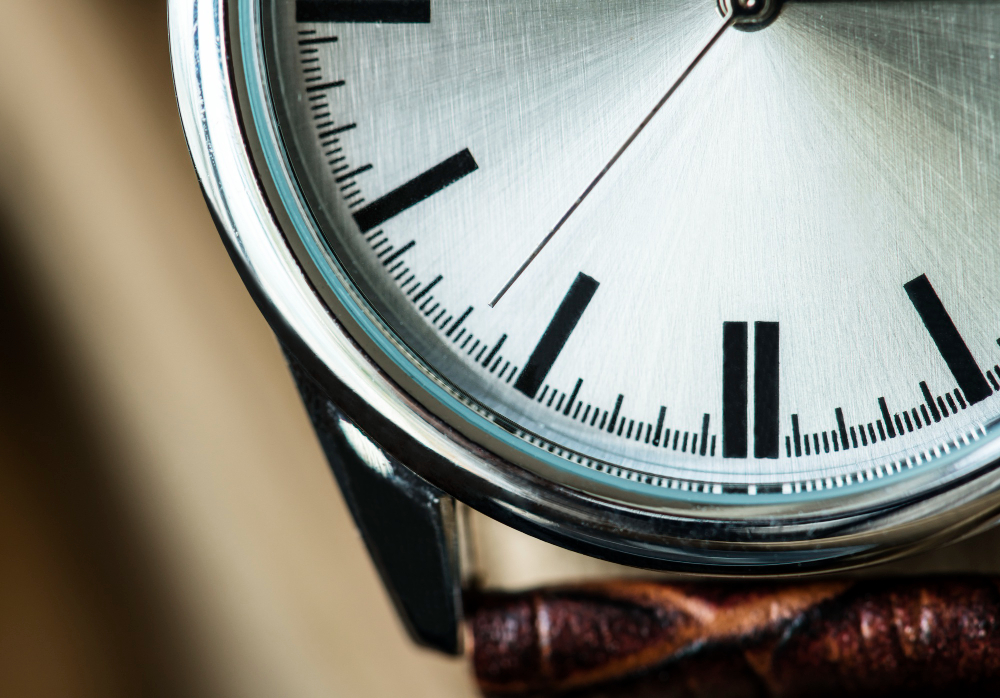
3 ATM water resistance means the watch is prepared above all for rain, accidental splashes and brief contact with water during everyday activities. It does not mean that you can swim with it, shower in it or submerge it to a depth of 30 metres. It is precisely the “30 m” marking that most often misleads. It is the result of a pressure test carried out under controlled conditions, not a declared working depth. So if you see 3 ATM, 3 bar or Water Resistant 30 m on the case back or in the specification, treat the watch as resistant to everyday moisture, but not as a watch for water activities.

Rolex-style watches – the best alternatives to the Submariner, Explorer and Datejust
For years Rolex has been one of the most important style benchmarks in the watch world, but its price is not within everyone's reach. That is why it is worth looking at watches similar to Rolex and models inspired by its styling, which offer their own character, solid build quality and much more affordable prices. We are not talking about counterfeits here, but about legitimate watches from other brands that draw on similar solutions and design language. Check out watches inspired by Rolex's style and choose the model that suits your style and budget.
A bronze watch – why does each one change over time?
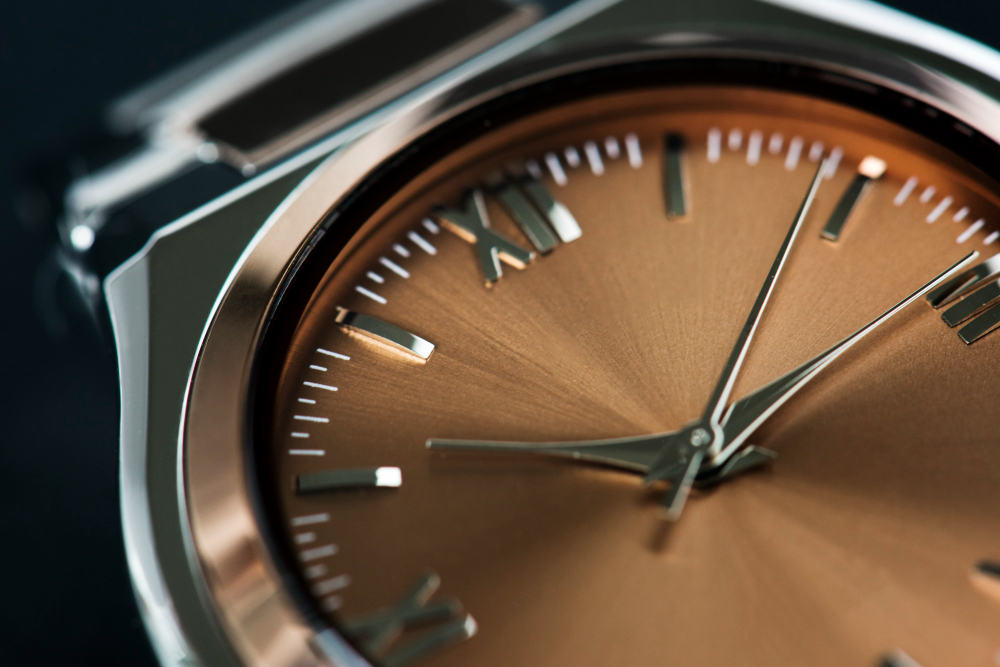
A bronze watch stands out because its appearance changes along with its owner. The case gradually darkens, turns matte and develops a patina, so two identical models can look completely different after just a few months. This is the greatest advantage of bronze, but also a trait you need to accept before buying. If you expect a watch that keeps its factory shine for years, steel may be a better direction. If, on the other hand, you like vintage looks, signs of use and the natural ageing of a material, bronze gives an effect that is hard to achieve in any other metal.