



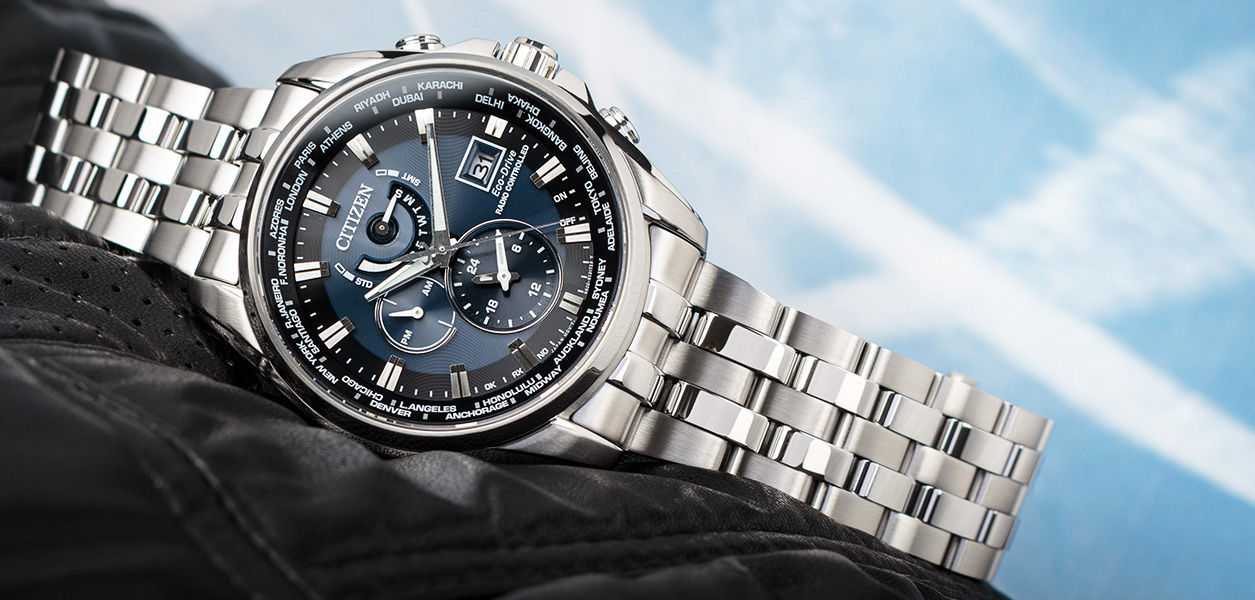
What is GMT time and how can you use this function on your watch?
Not every watch shows just one time – some can do much more. The GMT function allows you to track time in two, or even three time zones simultaneously, making it perfect for travelers, pilots, and people working internationally. Before you learn how it works and what the GMT time zone actually is, it's worth knowing its history – from London's Greenwich to modern watches with the most advanced mechanisms.
GMT – what does it mean? Discover the fascinating history of time from which the whole world counts
Although you don't think about where the time you see on your watch dial comes from on a daily basis, it's worth knowing that it all starts with GMT, or Greenwich Mean Time. This term refers to mean solar time on the prime meridian, which runs through the London district of Greenwich. It was this point on the map that became the baseline from which all other time zones began to be measured.
This is where the name GMT time zone came from, which for decades has been the reference point for the entire world – in shipping, aviation, and everyday life. In practice, if you hear that someone operates in GMT+2 time, it means their local time is two hours ahead of London. It's a simple system, but extremely important for synchronizing work, travel, and global communication.
It's worth knowing that GMT's history dates back to the 17th century, when the Royal Astronomical Observatory was established in Greenwich. It was there that it was determined that the meridian passing through this point would be considered "zero." Over time, the system was adopted by other countries, and in 1884, at an international conference, it was established as the official standard. Interestingly, France long opposed these arrangements, preferring its own Paris meridian – it wasn't until 1911 that it officially recognized Greenwich. Today, GMT serves mainly a historical function, as it was replaced in the 1960s by the more accurate UTC (Coordinated Universal Time), but for watch users and in everyday language, the concept of GMT is still alive. It was this concept that became an inspiration for watchmakers who began creating models that allow tracking more than one time zone.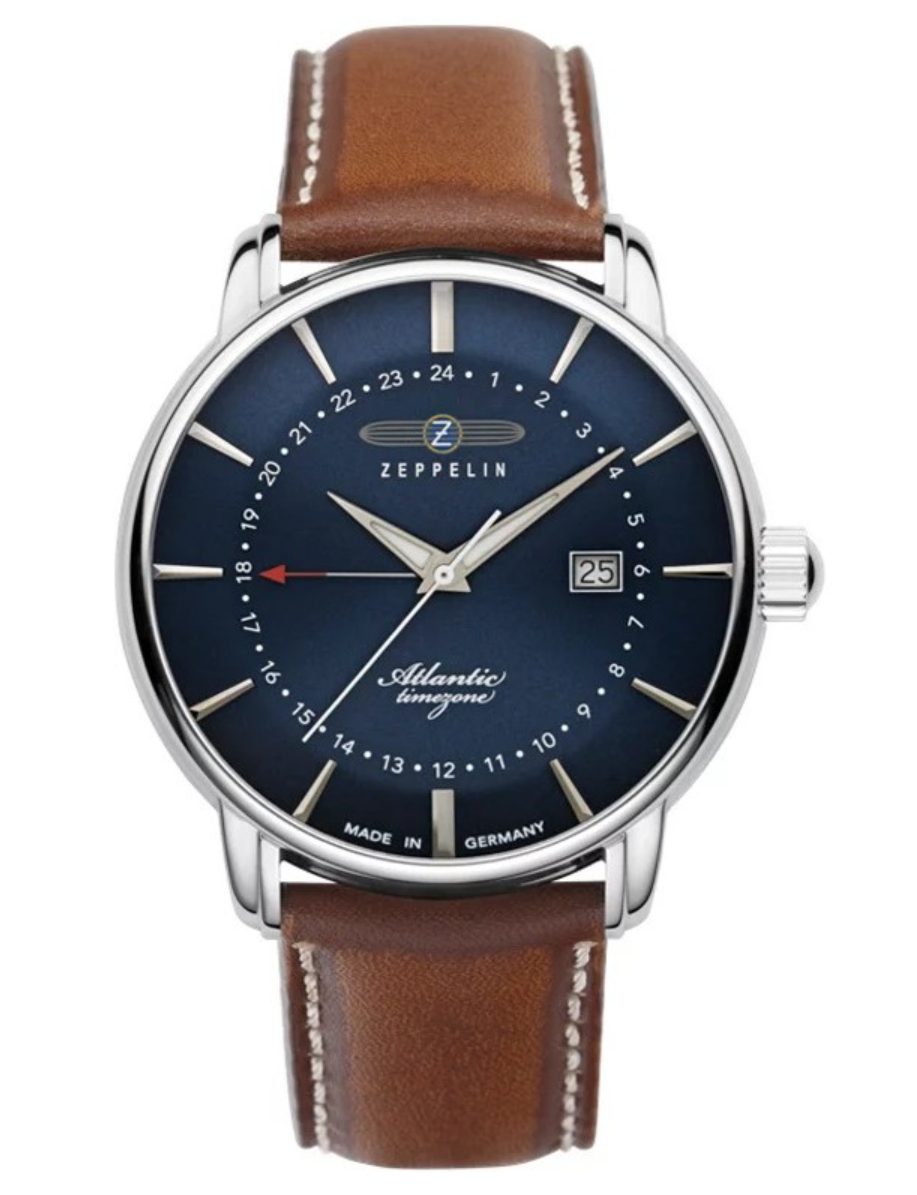
Zeppelin Atlantic GMT 8442-3 is an elegant men's watch that values classics and functionality in a modern edition. With a navy blue dial, leather strap, and GMT complication, it's perfect both for travel and business meetings, emphasizing the style, class, and precision of German watchmaking craftsmanship.
How the GMT function works in a watch – discover how to read time in two (or even three) time zones simultaneously
The GMT function in a watch is something many consider one of the most practical mechanical complications. Its operation is simple but extremely useful. On the dial, you'll find an additional hand – often ending with a characteristic triangle-shaped arrow. This is the GMT hand, which makes a full rotation once every 24 hours, not twice like the standard hour hand. This makes it easy to distinguish whether it's day or night in the second time zone. Usually, the dial or ring (called the bezel) features a 24-hour scale that allows you to read the time in another part of the world. In practice, you can simultaneously track, for example, local time and time in the country you're from.
Some watches go a step further – they're equipped with a rotating bezel that allows reading even a third time zone. Simply turn the ring forward or backward by the appropriate number of hours, and you'll know what time it is in Tokyo or New York, for example. This solution is appreciated by both travelers and people who collaborate with partners from different parts of the world. With the GMT function, you don't have to calculate hours "in your head" or check time differences on your phone – you have everything on your wrist. Moreover, GMT time displayed this way is extremely readable and allows you to immediately orient yourself in time regardless of which part of the globe you're in.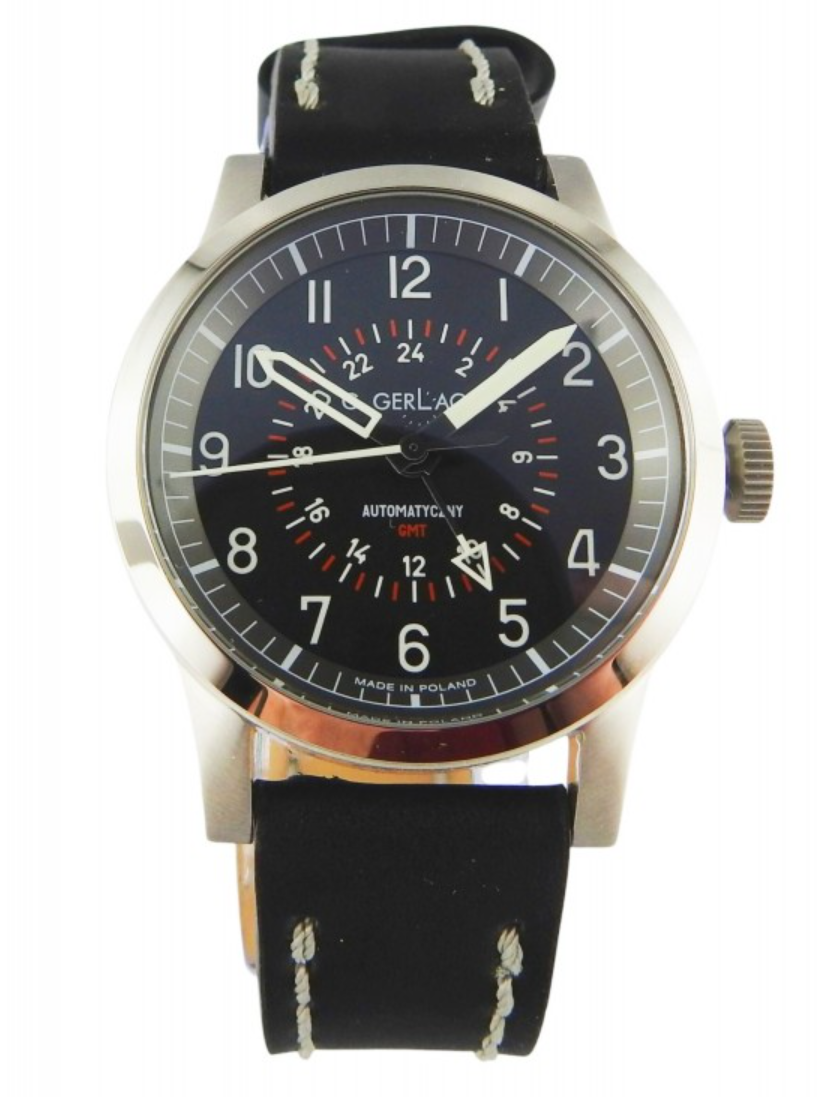
Gerlach PZL P.50 Jastrząb GMT is a tribute to Polish aviation and technical precision, inspired by the legendary fighter from the 1930s. Equipped with an automatic movement with GMT function, it combines military character with elegance and solid craftsmanship, creating a watch ideal for history and aviation adventure enthusiasts.
True GMT or Caller GMT? Check which type of watch suits your lifestyle
Not every watch marked GMT works the same way, so it's worth knowing that there are two main types – True GMT (Flyer GMT) and Caller GMT (Office GMT). The difference between them is subtle, but significant for the user. In True GMT models, the main hour hand moves independently, allowing you to quickly adjust local time without interfering with the GMT hand, which remains set to home time. This solution was created with frequent travelers who cross different time zones in mind – it takes just a moment to adjust the watch to a new location.
On the other hand, Caller GMT works better if you don't physically change time zones but want to track time in another place – for example, when you work with international clients or have family in another country. In this type of mechanism, the GMT hand is adjusted independently, while local time remains unchanged. This makes it easy to set the appropriate time in, for example, New York, Tokyo, or Sydney, without needing to change the main clock. This is why watches of this type are often called "office" watches – ideal for people who constantly function between different time zones but don't necessarily travel. Both types have their advantages, and the choice between them depends primarily on whether you want a watch ready for travel or rather for remote contacts. Both types – True GMT and Caller GMT – can be found in our online watch store, where models await that are suited to both the traveler's lifestyle and people working remotely with partners from different parts of the world
GMT time zone in practice – how to set and use the GMT function in everyday use
Understanding how the GMT function works is one thing, but only its practical use shows how much it can make life easier. Most watches with this complication have three crown positions: the first – for everyday wear, the second – for setting the date and GMT hand, and the third – for adjusting the main time. In practice, setting is straightforward: first you set local time, and then, using the second crown position, you adjust the GMT hand to the second time zone. If the watch has a rotating bezel, you can use it to read yet another time by rotating the ring forward or backward by the appropriate number of hours.
Such a GMT time zone in a watch is a tool you'll appreciate not only during intercontinental flights. It will also be useful if you collaborate with people in other parts of the world, follow sporting events broadcast from another continent, or simply want to know what time it is where someone close to you lives. Interestingly, in many modern GMT watches, this function is not only practical but also aesthetic – the fourth hand and 24-hour scale add character to the dial. Thanks to this, a GMT watch becomes a combination of utility and timeless design that has more to offer than simply measuring time. In our store, you'll find both men's watches and women's watches with GMT function that combine time measurement precision with elegant design and practical application in everyday life.

Krzysztof Szopa
Watch Expert
An expert associated with the WestWatches.pl brand, a place that has been providing watches for every occasion for years. Thanks to many years of experience in the watchmaking and jewelry industry, he passionately shares his knowledge, offering professional advice both in the online and physical store. He specializes in selecting original watches, watch accessories, and jewelry products that combine exceptional quality with competitive prices. His goal is to help customers find the ideal product that will meet their expectations and emphasize their style.

See popular articles
Watches for seniors – the top 5 gift ideas for older people
Choosing the right watch for a senior is more than just buying a practical accessory – it’s a decision that affects an older person’s comfort in daily life and their general well-being. This selection features models that combine readability, comfort and timeless style, whilst catering to a range of needs – from elegant classics to durable sports watches.
Which battery for a wristwatch – how not to confuse SR, LR and CR?
Choosing the right battery for your watch is a topic that often seems trivial… until you find yourself standing in front of a shelf full of different labels and have no idea what to choose. SR, LR, CR, numbers like 377 or 364 – they all look similar, yet the differences are huge and have a real impact on how your watch works. If you want to avoid making the wrong purchase and ensure your watch works exactly as it should, it’s worth learning a few simple rules that will clear up most of your doubts.
Watches for girls for First Communion – a ranking of the best gift options
First Holy Communion is a special occasion that deserves an equally special gift. A watch for a girl to mark her First Holy Communion is not only an elegant accessory, but also a keepsake for years to come – a symbol of growing up, personal style and those first important moments captured in time. In this guide, you’ll find suggestions that combine beautiful design, functionality and timeless appeal.
On which wrist should you wear a ladies’ watch? Find out what’s comfortable and what’s just a matter of habit
At first glance, it may seem like a minor detail, but in practice it can make a real difference. Choosing which wrist to wear a watch on isn’t just a matter of habit or fashion – it’s about comfort, functionality and how the watch fits in with your everyday lifestyle. Some people don’t even give it a second thought, whilst others try out different options before finding the right one. If there is any doubt as to whether there is a single ‘correct’ answer – it is worth dispelling it once and for all and looking at the matter from a practical perspective.
First Communion watches for boys – a ranking of the best models for a special gift that will last for years
which can be a companion for years to come. In this guide, we’ve compiled a selection of models that combine style, functionality and timeless appeal, making it easier to find the perfect watch for a boy – one that suits his age, interests and first ‘grown-up’ choices.
How do you adjust a watch that’s running fast?
Have you noticed that your watch is running fast and are starting to lose confidence in it? Don’t worry – this doesn’t necessarily mean there’s a serious fault. In many cases, it’s a natural characteristic of the mechanism or the result of minor factors that can be quickly diagnosed. Find out what to do if your watch is running fast, when observation is enough, and when specific adjustment or a visit to a watchmaker is needed.
Replacing the battery and closing the watch – what should you watch out for?
Changing a watch battery seems like a simple task – a few minutes, a quick swap, and you’re done. In practice, however, this is a moment when it’s easy to make a small mistake that ends up costing far more than the battery itself. It’s not just about getting the watch working again, but about doing so in a way that’s safe for the movement, the case and… the water resistance. If you want to avoid common pitfalls and be sure that everything has been done properly – check out what you really need to pay attention to.
Watch dial restoration – when is it worth it, and when is it better to give it a miss?
Not every watch dial restoration is a good idea – sometimes you improve the appearance, but lose something far more important. The line between refreshing the look and losing the original character is a fine one, and a single decision can affect not only the aesthetics but also the value of the entire watch. If you’re wondering whether restoring watch dials makes sense in your case, it’s worth looking at the issue more broadly – not just in terms of ‘prettier’, but above all ‘better’.
How can I clean my watch face without risking damage?
At first glance, it might seem like just a quick wipe of the glass – but in reality, it’s one of the most common mistakes, which can permanently ruin the appearance of your watch. If you want the dial to look as good as new for years to come, it’s worth knowing what to avoid at all costs and how to clean it safely – without the risk of scratches, tarnishing or costly repairs.