



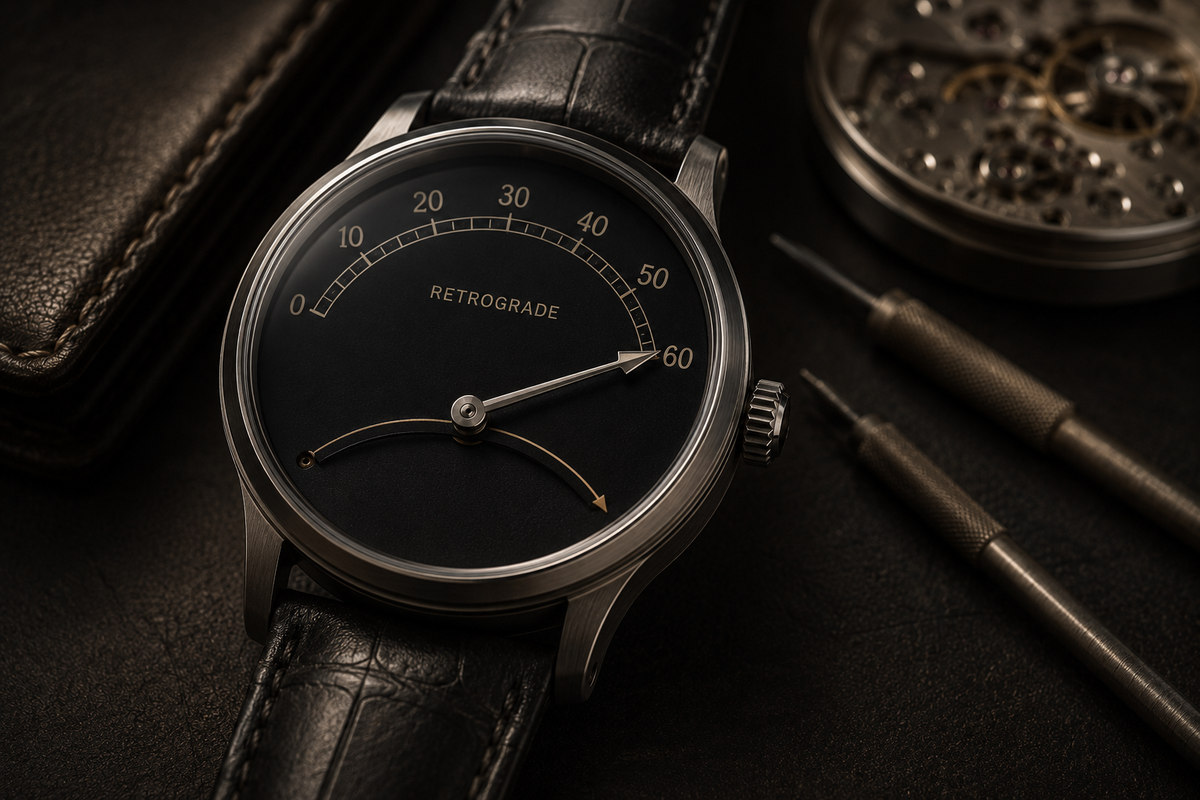
Retrograde hand — how does a retrograde hand work?
The retrograde is a watch complication that catches the eye immediately. Instead of making a full sweep around the dial, the hand travels along a defined arc, and once it reaches the end of the scale, it instantly snaps back to the beginning and starts counting again. In this way it can display the date, day of the week, minutes, seconds, power reserve, or the time in a second zone. This striking movement is therefore not merely decorative, but part of a precisely engineered mechanism. Find out how a retrograde indication works and in which watches you can see it in practice.
What is a retrograde?
A retrograde, meaning a returning or reverse indication, shows a given piece of information on a scale shaped like an arc or a line. When the hand reaches the final value, it does not continue moving in a circle. It instantly returns to the start of the scale and begins another cycle. The Fondation Haute Horlogerie defines the retrograde as an hour, minute, second, or calendar indication that returns to zero immediately once the cycle is complete.
The easiest way to explain this is with a retrograde date example. Over the following days the hand moves from 1 to 31. At the end of the month it makes a swift movement in the opposite direction and returns to position 1. In the case of a seconds hand the cycle may last 30 or 60 seconds, whereas the minute hand usually returns after a full hour has passed.
A retrograde complication can handle:
- the date of the month,
- the day of the week,
- minutes or seconds,
- the power reserve,
- a second time zone indication,
- the hours in unusual constructions,
- astronomical and calendar information.
The term bi-retrograde means that a watch has two independent returning indications. An example is the Vacheron Constantin Patrimony Retrograde Day-Date, in which separate hands show the day of the week and the date. This model's movement is made up of 276 components, runs at a frequency of 4 Hz, and offers around 40 hours of power reserve.
The history of this construction is far longer than the history of modern wristwatches. Breguet points out that Abraham-Louis Breguet was among the first watchmakers to refine the retrograde date indication and used it in his creations. In the 20th century the solution became particularly recognisable thanks to unusual pocket watches and designs from the 1920s and 1930s, which today's haute horlogerie collections still reference.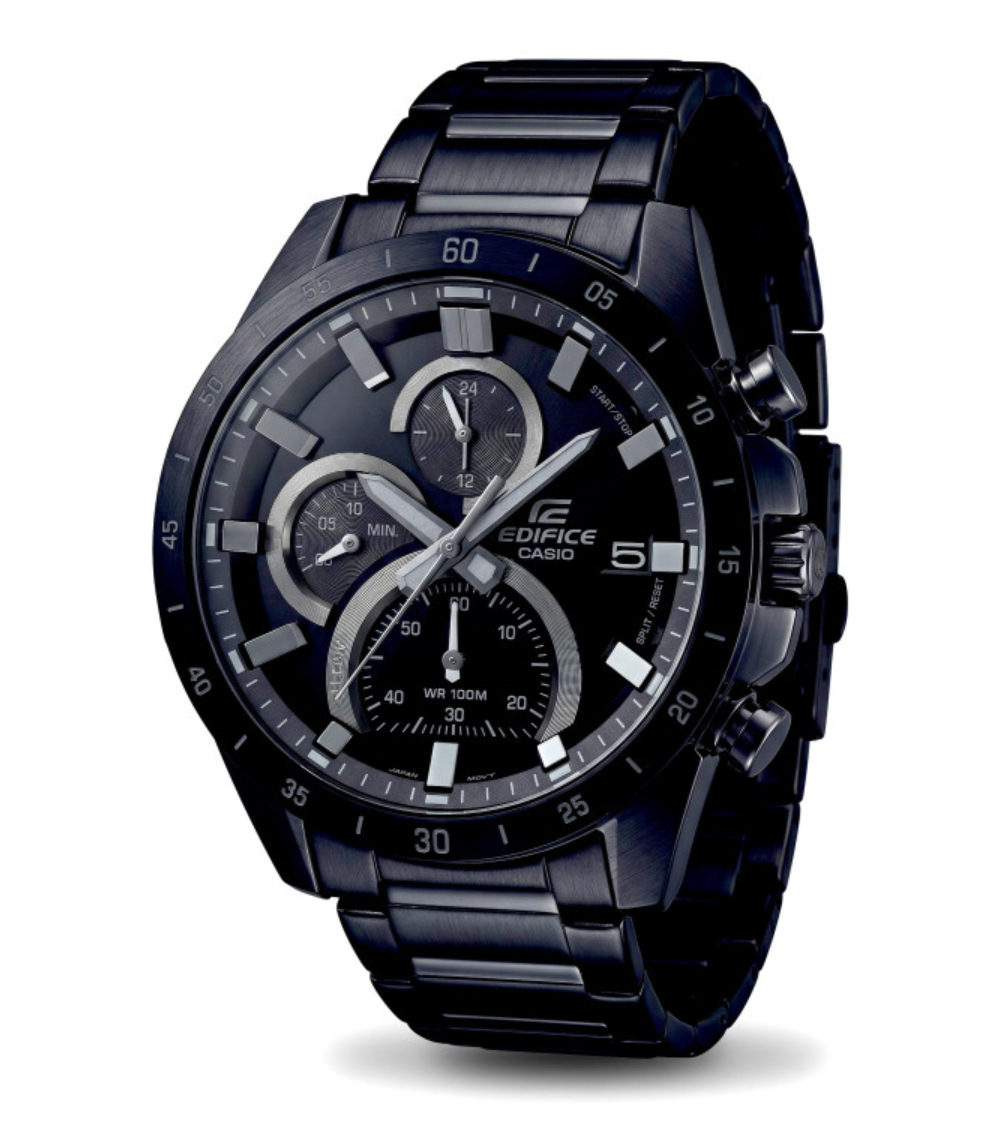
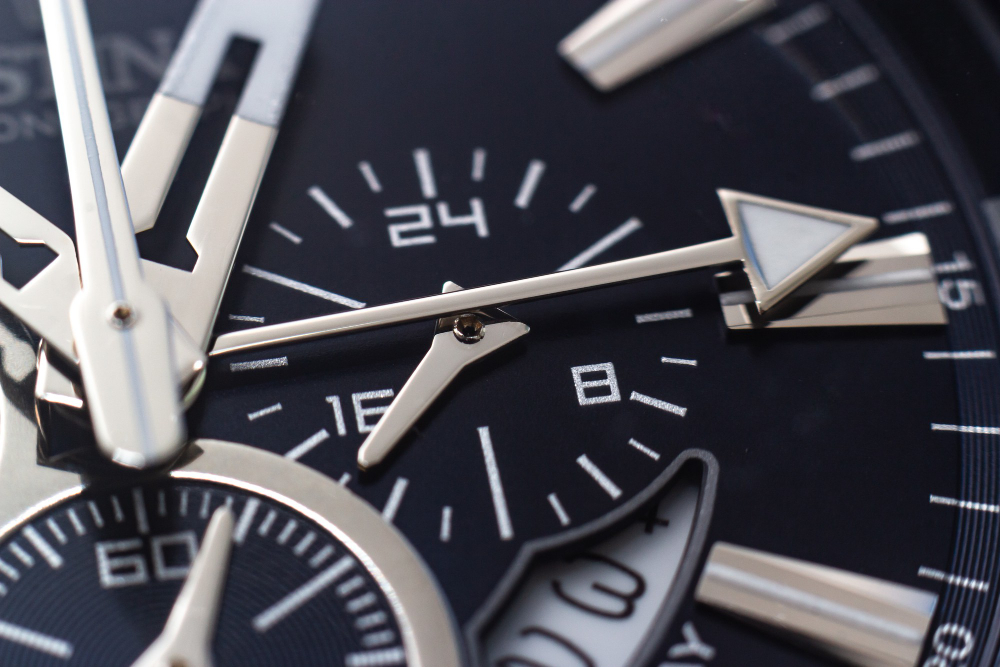
Casio Edifice Momentum EFR-571MDC-1AVUEF shows the retrograde in a sporty guise. The chronograph's minute counter at 9 o'clock moves along an arc and, once the cycle is complete, returns to the starting position. The model stands out with its massive case, dark steel bracelet, and water resistance up to 100 metres.
How does a retrograde indication work?
The retrograde mechanism turns the uniform motion of the watch's gear train into a gradual advance of the hand followed by its abrupt return. This is handled by, among other things, gears, a cam, a lever or rack, and a tensioned spring. Individual constructions differ in their build, but the principle remains similar: throughout the cycle the mechanism stores the energy needed to perform the return movement.
In a retrograde date the calendar gear train advances the hand by one segment each day. At the same time, a lever working with the cam gradually tensions the spring. When the watch mechanisms reach the last value of the scale, the lever hits the steep drop of the cam. The stored energy is then released, and the hand returns from the end of the scale to the beginning. A retrograde complication can handle many different indications, including the date of the month, the day of the week, minutes, seconds, the power reserve, and the time in a second zone. In more elaborate constructions it is also used to present the hours, astronomical data, and additional calendar information.
For the user, the whole process looks like a simple jump. Inside the case, however, several precisely synchronised components must work together. The hand must not return too slowly, bounce off the stop, or halt between the markings. The mechanism must also control the return energy, since an abrupt movement increases the load on the parts. The most spectacular moment depends on the function being displayed. The date returns once a month, the day-of-the-week hand once every seven days, and a retrograde seconds hand can perform this movement every minute.
Why does the retrograde indication attract attention?
The retrograde indication combines functionality with the spectacular movement of the hand. Instead of a full sub-dial, the manufacturer can use an arc on which the date, day of the week, power reserve, or another indication is presented. As a result, the dial gains a distinctive layout, while the additional information remains clearly separated from the hours and minutes.
A good example is the Vacheron Constantin Overseas Moon Phase Retrograde Date, which combines the retrograde date with a moon phase indication. The model has a case 41 mm in diameter, a movement made up of 275 parts, a 40-hour power reserve, and water resistance up to 50 metres. The retrograde appears, however, not only in classic luxury watches but also in sporty-elegant constructions, which is why its character depends above all on the dial design and the type of function being presented.
The popular ETA movement, on the other hand, offers the quartz calibre G15.562 BE with a perpetual calendar, in which the retrograde hands can present the date, the day of the week, and the month. The movement has a diameter of 23.3 mm, a height of 5.25 mm, six jewels, and a battery with a declared lifespan of around 35 months. Unlike traditional mechanical complications, the return of the hands is here controlled by quartz drives, yet the effect on the dial remains similar – once it reaches the end of the scale, the hand quickly returns to the starting position. 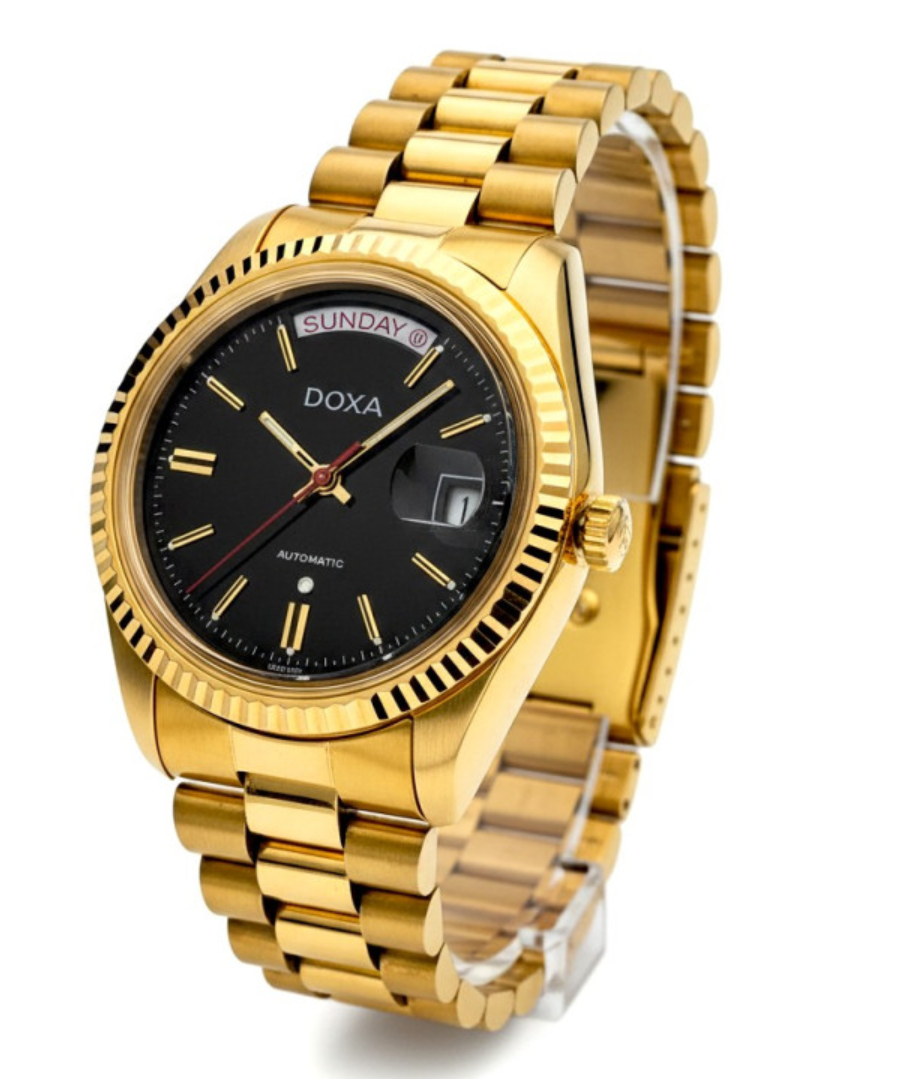
An example of a watch with an ETA movement and a practical date is the DOXA T-5634 Day-Date Automatic, available in the WestWatches range. This vintage model uses the automatic ETA 2834-2 calibre, which handles both the date of the month and a full day-of-the-week indication. The date is placed at 3 o'clock and fitted with a magnifying lens, while the day of the week is presented in a window at 12 o'clock. This is not a retrograde complication, but a classic example of an extensive calendar based on a Swiss ETA movement.
Which watches have a retrograde indication?
The retrograde appears above all in mechanical watches from premium brands and manufactures specialising in elaborate complications. The returning hand may present a single simple function or work together with a perpetual calendar, moon phases, a tourbillon, and a jumping hour.
|
Model |
Type of retrograde indication |
Key features |
|
Vacheron Constantin Patrimony Retrograde Day-Date |
day of the week and date |
two retrograde indications, 42.5 mm case, movement with 276 parts, 40 hours of power reserve |
|
Vacheron Constantin Overseas Moon Phase Retrograde Date |
date |
41 mm case, moon phases, 275 parts, 40 hours of power reserve, 50 m water resistance |
|
Patek Philippe Ref. 6159G-001 |
date in a perpetual calendar |
39.5 mm case, movement with 368 parts, moon phases, 35–45 hours of power reserve |
|
Chronoswiss Delphis |
minutes |
retrograde minutes, jumping hour, continuous small seconds |
|
Breguet Tradition Quantième Rétrograde 7597 |
date |
40 mm case, movement with 269 parts, 50 hours of power reserve |
|
Longines Master Collection Retrograde |
several functions depending on the version |
a recognisable historic series with an elaborate arrangement of returning indications |
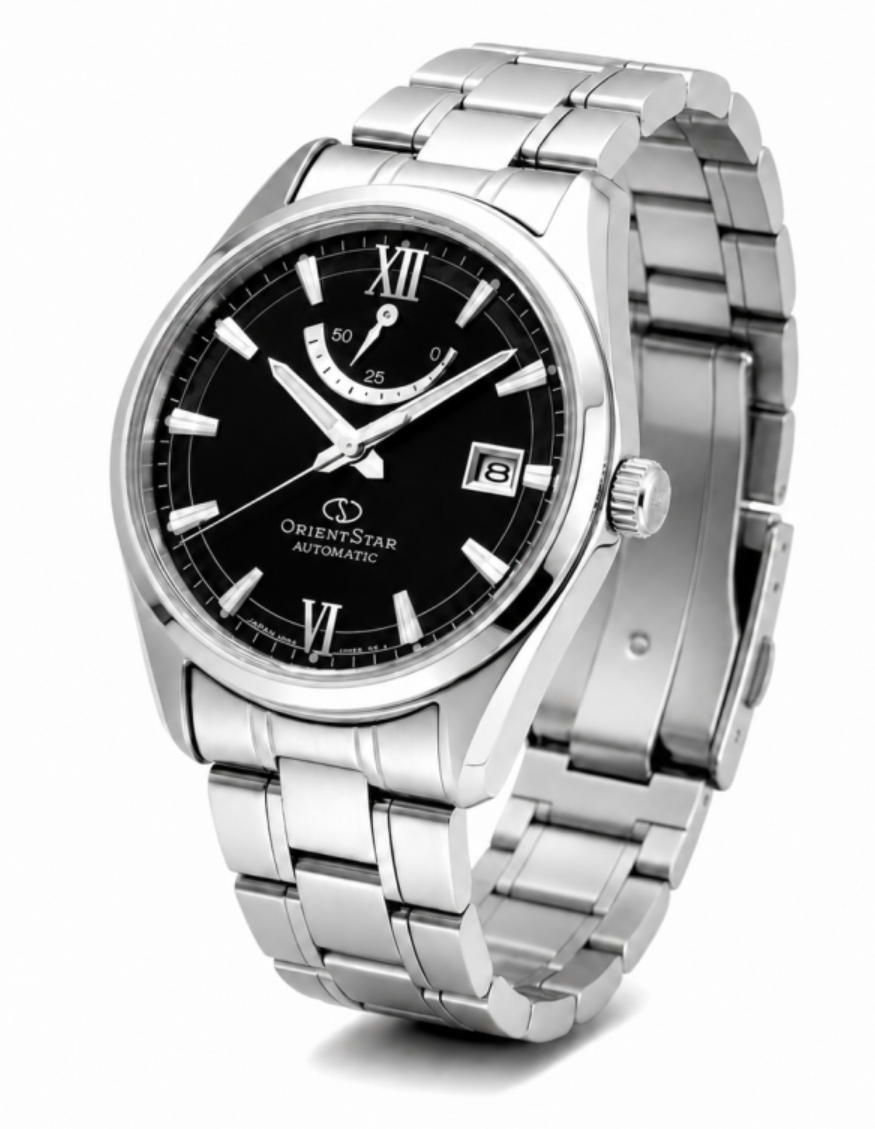
Orient Star Contemporary Automatic RE-AU0004B00B shows how effectively an arc-shaped scale can be used on a dial. The power reserve indicator is not a retrograde complication, but it similarly organises additional information and gives the watch a technical character. The automatic Orient F6N43 movement, a date, and a compact 38.5 mm case mean that the model combines an interesting look with everyday wearing comfort.
The retrograde indication shows how effectively precise mechanics can be combined with a legible presentation of additional functions. In the online watch shop WestWatches you will find both models that use similar solutions on the dial and practical men's watches with a date, a power reserve indicator, or an elaborate chronograph. This is a good direction if you are looking for a watch that stands out with a detail while remaining functional every day.

Krzysztof Szopa
Watch expert
An expert associated with the WestWatches.pl brand, a place that has been supplying watches for every occasion for years. Thanks to many years of experience in the watchmaking and jewellery industry, he passionately shares his knowledge, offering professional advice both in the online shop and in the brick-and-mortar store. He specialises in selecting original watches, watch accessories, and jewellery products that combine exceptional quality with competitive prices. His goal is to help customers find the ideal product that will meet their expectations and highlight their style.

See popular articles

316L, 904L and surgical steel – what is your watch made of?
Most steel watches, from affordable models to luxury constructions, are made of 316L steel. 904L steel contains more nickel, chromium and molybdenum, and therefore offers higher corrosion resistance, but in itself it does not mean greater scratch resistance. The term “surgical steel”, in turn, does not point to one strictly defined alloy. In watches it most often refers to 316L, but without a specific material designation it may simply be a marketing name. If you are choosing a watch for years, look therefore not only at the words “stainless steel”, but also at the grade of steel, which components are made of the given material and how they are finished.
Japanese or Swiss watches? We compare quality, movements and prices
If you are wondering whether Japanese or Swiss watches are better, the name of the country alone will not give you a good answer. In both cases you will find simple models for relatively little money, solid mid-range automatics and designs belonging to the world's watchmaking high end. Far more about quality will be told to you by the specific movement, the way the case and bracelet are made, the crystal, quality control, accuracy and price. Check how Japanese watches really differ from Swiss ones and what to pay attention to before you choose a model for yourself.

The lifespan of a quartz watch – how long does it really last, and when is it no longer worth repairing?
We value quartz watches above all for their accuracy, convenience and modest day-to-day demands. That does not mean, however, that they can run indefinitely and need nothing more than a new battery once every few years. Over time, the components of the movement itself also wear out, and the moment a watch starts giving trouble can look completely different depending on the model, the way it is used and the availability of parts. So how long can a quartz watch last, what wears out in it most often and when does repair still make sense? Check what its lifespan really depends on.

The second hand on a watch – why does it jump, move smoothly or stop?
The way the seconds hand moves can tell you a lot about a watch's movement, but it is not an infallible test. A single distinct jump per second most often points to quartz, several small movements per second are typical of a mechanical movement, and an almost continuous glide is associated with Spring Drive. There are exceptions, however: there is a quartz watch with a sweeping seconds hand, and a mechanical watch that makes exactly one jump per second. What is more, a stopped hand does not have to mean a fault. Check how to read these signals and when you really need a watchmaker's help.

How do you set an automatic watch? Date, time and time zone 21:00–3:00
An automatic watch does not need a battery, but it does require a little knowledge from its owner. Setting the time or date seems simple, yet the wrong moment or the wrong way of using the crown can affect how the movement works. Many questions concern changing the date at night, moving the hands backwards and restarting a watch after a longer break. Check how to set an automatic watch correctly, what to pay attention to with the crown and why people often talk about particular caution between 9:00 pm and 3:00 am.

Wodoszczelność 10 ATM i 20 ATM – czy możesz pływać i nurkować z takim zegarkiem?
Co naprawdę oznacza 10 ATM lub 20 ATM na zegarku i czy takie oznaczenie pozwala bez obaw wejść do basenu, morza albo nurkować? Same liczby mogą być mylące, dlatego sprawdź, jak czytać klasę wodoszczelności i dobrać zegarek do aktywności w wodzie.
Water resistance 3 ATM – what does it mean and what can you do with it?
3 ATM water resistance means the watch is prepared above all for rain, accidental splashes and brief contact with water during everyday activities. It does not mean that you can swim with it, shower in it or submerge it to a depth of 30 metres. It is precisely the “30 m” marking that most often misleads. It is the result of a pressure test carried out under controlled conditions, not a declared working depth. So if you see 3 ATM, 3 bar or Water Resistant 30 m on the case back or in the specification, treat the watch as resistant to everyday moisture, but not as a watch for water activities.

Rolex-style watches – the best alternatives to the Submariner, Explorer and Datejust
For years Rolex has been one of the most important style benchmarks in the watch world, but its price is not within everyone's reach. That is why it is worth looking at watches similar to Rolex and models inspired by its styling, which offer their own character, solid build quality and much more affordable prices. We are not talking about counterfeits here, but about legitimate watches from other brands that draw on similar solutions and design language. Check out watches inspired by Rolex's style and choose the model that suits your style and budget.
A bronze watch – why does each one change over time?
A bronze watch stands out because its appearance changes along with its owner. The case gradually darkens, turns matte and develops a patina, so two identical models can look completely different after just a few months. This is the greatest advantage of bronze, but also a trait you need to accept before buying. If you expect a watch that keeps its factory shine for years, steel may be a better direction. If, on the other hand, you like vintage looks, signs of use and the natural ageing of a material, bronze gives an effect that is hard to achieve in any other metal.